Kit (ConvertKit) vs InfluencersKit: The Honest Comparison for Creators Who Want to Monetize
Kit was built for creators who sell courses and digital products. InfluencersKit was built for creators who monetize through ads, sponsorships, and paid subscriptions. Direct, fair, data-driven comparison — with real pricing at every tier and a clear verdict by creator type.
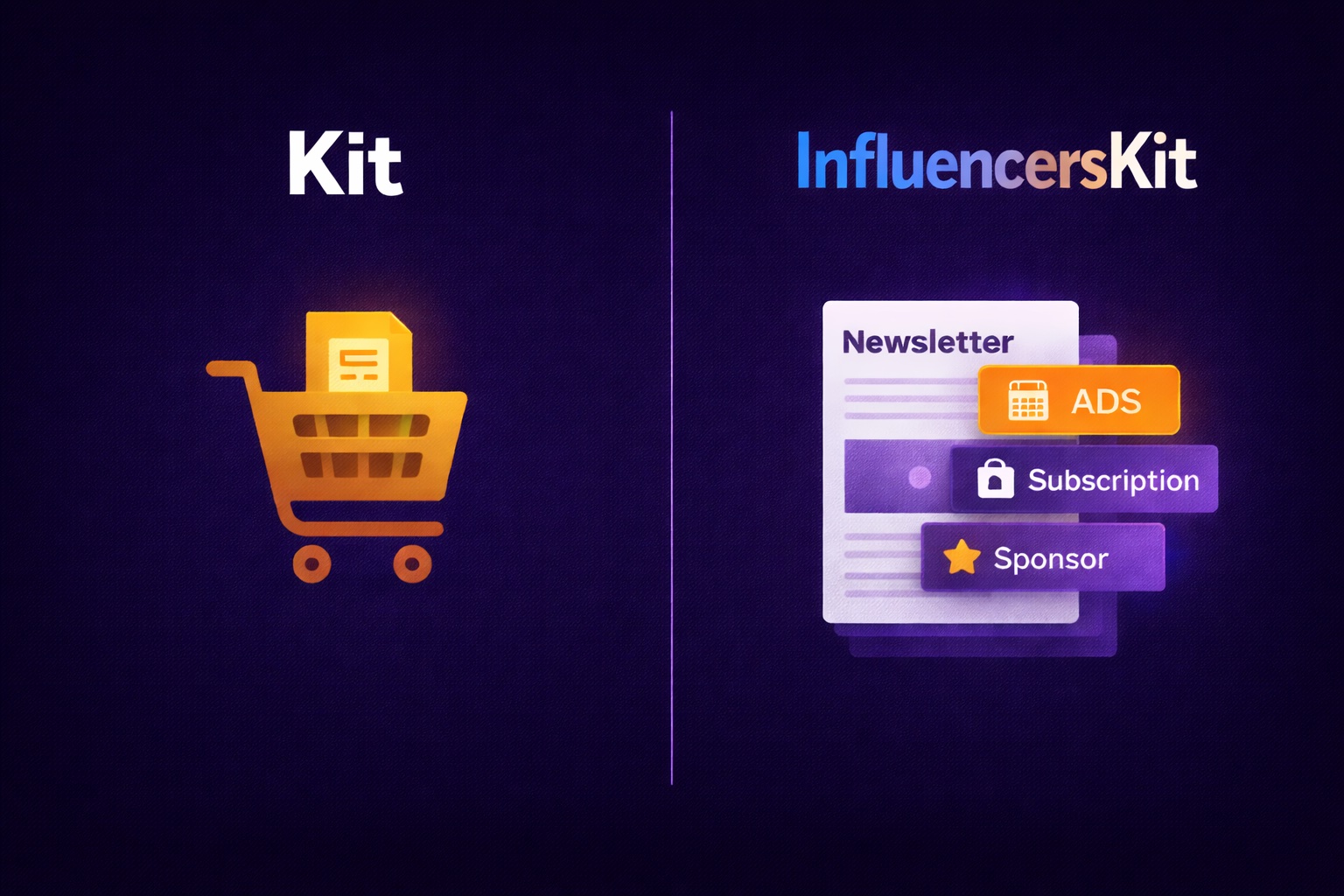
Kit (the platform formerly known as ConvertKit) and InfluencersKit have similar names, overlapping audiences, and genuinely different purposes. This comparison exists specifically because creators searching for one often encounter the other — and because the decision between them has a meaningful impact on both monthly cost and revenue potential.
The short version: Kit was built for creators who sell things — courses, digital products, memberships. It's a sophisticated email platform with commerce features, and it does that job well. InfluencersKit was built for creators who publish — newsletters, content, analysis — and want to monetize that publishing through ads, sponsorships, and paid tiers. Very different products for creators who sound similar but have different primary revenue models.
This guide does the comparison honestly. Kit has real advantages that belong in the column labeled "Kit wins." InfluencersKit has real advantages in the column labeled "InfluencersKit wins." And the conclusion — who should use which — is specific enough to be actually useful rather than the hedged non-answer most platform comparisons produce.
Kit vs. InfluencersKit: Why This Comparison Matters
Kit rebranded from ConvertKit in 2024 — which created a minor naming collision with InfluencersKit. Creators evaluating email platforms increasingly see both in the same searches and comparison threads. The naming similarity aside, they represent genuinely different philosophies about what a creator email platform should do.
Kit's philosophy: email is the monetization layer for creators who sell digital products. Build the list, nurture the relationship, convert to buyers. The platform is architected around that funnel.
InfluencersKit's philosophy: the newsletter is itself the product — and monetizing it directly (through ads, sponsorships, and paid subscriptions) shouldn't require five different tools. The platform is architected around newsletter-as-business-model, not newsletter-as-sales-funnel.
Neither philosophy is wrong. The right platform depends on which one matches your actual revenue model.
Who Each Platform Was Actually Built For
Kit was designed for:
- Creators selling online courses, digital downloads, and memberships
- Coaches and consultants using email as a sales funnel for services
- Bloggers and YouTubers who primarily monetize through product launches
- Creators who need sophisticated tagging and segmentation to run complex buyer journeys
- Creators who want to accept payments for products through the same platform as their email
InfluencersKit was designed for:
- Newsletter creators whose primary revenue comes from ads and sponsorships
- Creators launching or scaling paid newsletter subscription tiers
- YouTubers, podcasters, and social creators converting platform audiences into an owned email list with built-in monetization
- Independent media operators who treat their newsletter as a publication, not a sales sequence
- Creators who want programmatic ad revenue without managing a third-party ad network integration
The clearest signal for which platform you need: where does your revenue come from? If it's courses and products → Kit. If it's ads, sponsorships, and subscriptions → InfluencersKit.
Pricing Comparison at Every Tier (Real Numbers)
Kit pricing (annual billing, approximate early 2026):
- Free: Up to 10,000 subscribers (limited features — no automations, no paid subscriptions)
- Creator ($25/month): Up to 1,000 subscribers — automations, landing pages, basic commerce
- Creator Pro ($50/month): Up to 1,000 subscribers — adds newsletter referral system, subscriber scoring, advanced reporting
- At 5,000 subscribers (Creator): $66/month
- At 10,000 subscribers (Creator): $100/month
- At 25,000 subscribers (Creator): $166/month
- At 50,000 subscribers (Creator): $279/month
Kit also takes a 3.5% + $0.30 fee on digital product sales through their Commerce feature.
InfluencersKit pricing:
See current pricing page for up-to-date tiers — the model is structured around active subscribers with no percentage cuts on ad revenue or subscription income. The comparison that matters most: at equivalent subscriber counts, InfluencersKit is typically 40-60% of Kit's cost for newsletter creators who don't need Kit's digital commerce features.
The hidden cost difference — revenue percentage cuts:
- Kit on paid subscriptions: Charges 3.5% + payment processing on digital product sales. No native paid newsletter subscription — you'd use a tool like Patreon or build a workaround.
- InfluencersKit on paid subscriptions: 0% platform fee. You keep everything minus Stripe's standard processing charge (~2.9% + $0.30).
- At $3,000/month in subscription revenue: Kit takes $105+ in platform fees. InfluencersKit takes $0.
- Annualized at $3,000/month subscription revenue: $1,260/year difference in platform fees alone — before accounting for the platform subscription cost difference.
Monetization: Where InfluencersKit Wins Decisively
This is the column where the comparison becomes most one-sided. For newsletter-native monetization, Kit was not designed to compete — it simply doesn't have the features in the same category.
Newsletter monetization feature comparison:
Programmatic ad monetization:
InfluencersKit: ✅ Built-in — earn from every issue with no minimum subscriber count, no external ad network to manage
Kit: ❌ Not available. Would require finding, applying to, and integrating a separate ad network.
Paid newsletter subscriptions (0% platform fee):
InfluencersKit: ✅ Native — fully integrated, 0% platform fee, subscriber management in the same dashboard
Kit: Partial — Kit Commerce handles digital product sales but is not designed for recurring newsletter subscriptions specifically. Workarounds exist but aren't native.
Sponsorship management:
InfluencersKit: ✅ Built-in sponsor dashboard with campaign tracking, click analytics, and rate management
Kit: ❌ Manage sponsors entirely outside the platform via email and spreadsheets
Digital product commerce:
Kit: ✅ Strong — native checkout, multiple product types, tip jars, pay-what-you-want pricing
InfluencersKit: Not Kit's primary focus — for creators selling courses or digital downloads, Kit has a more developed commerce layer
The bottom line on monetization:
If your revenue model is newsletters (ads + sponsorships + paid tiers), InfluencersKit provides substantially more built-in infrastructure. If your revenue model is digital products (courses, downloads, memberships), Kit's commerce layer is more developed. Creators trying to do both may need to evaluate which revenue stream is primary and optimize for that.
Automation & Segmentation: Where Kit Has the Edge
Kit is a stronger automation platform — and for creators whose business depends on complex subscriber journeys, that matters.
Kit automation advantages:
- Visual automation builder: Kit's visual flowchart builder is intuitive and genuinely powerful — conditional splits, event triggers, subscriber behavior branching, and sequences that can span months
- Tagging system: Kit's tag-based subscriber organization is among the most flexible in the industry — you can tag subscribers based on almost any action and build segments from any combination of tags
- Subscriber scoring: On Creator Pro, Kit tracks subscriber engagement and scores them — useful for identifying your most engaged readers for product launches
- Event-based triggers: Trigger automations based on link clicks, product purchases, form submissions, and subscriber behavior — more granular than most newsletter-native platforms
Honest assessment:
For a creator who needs to run: welcome sequence → buyer journey → post-purchase nurture → re-engagement → product launch sequence → upsell sequence — all with behavioral branching — Kit's automation is genuinely better. For a creator who needs: welcome sequence, re-engagement sequence, and occasional broadcast — both platforms handle it equally well, and InfluencersKit is simpler to configure.
Growth Features: Referrals, Landing Pages, Analytics
Referral program:
- InfluencersKit: ✅ Built-in referral program included — milestone rewards, personalized subscriber links, automated reward delivery
- Kit Creator Pro: ✅ Includes SparkLoop integration natively — cross-newsletter referral network access. The referral feature is included in Creator Pro ($50+/month at 1,000 subscribers), not the base Creator plan.
- Kit Creator (base): ❌ Requires separate SparkLoop account ($49+/month additional)
Landing pages:
- Kit: ✅ Strong landing page builder with multiple templates, good conversion optimization, easy to embed forms
- InfluencersKit: ✅ Landing page builder with newsletter-specific templates, conversion tracking, lead magnet delivery integration
- Both platforms handle landing pages well — Kit has more template variety, InfluencersKit has better newsletter-specific optimization
Analytics:
- Kit: Strong on subscriber behavior, purchase tracking, automation performance — oriented toward conversion analytics for product sales
- InfluencersKit: Strong on newsletter-specific metrics — revenue per subscriber, engagement scoring, ad performance, churn rate — oriented toward newsletter business health. See our full guide to the 8 newsletter metrics that actually matter.
Ease of Use and Setup Time
Time to first newsletter send:
- InfluencersKit: 45-90 minutes — account setup, list import, basic welcome sequence, and first issue template
- Kit: 60-120 minutes — account setup, sequence configuration, form setup. The automation builder is intuitive but more configurable, which means more initial decisions to make.
Learning curve:
- InfluencersKit: Lower learning curve for newsletter-focused creators. The platform surface area maps closely to what newsletter creators do — no features to ignore or navigate around.
- Kit: Moderate learning curve. The tag system and automation builder are powerful but require some time to configure correctly. Creators who don't need the advanced features may spend time learning things they'll never use.
Ongoing management:
- InfluencersKit: Newsletter dashboard shows what creators care about: ad revenue, subscriber growth, engagement score, upcoming sponsorships. Fewer clicks to the information you check daily.
- Kit: More feature surface area means more menus to navigate. Powerful for creators who use the full feature set; slightly cluttered for those who don't.
Who Should Use Kit vs. InfluencersKit
Choose Kit if:
- Your primary revenue model is online courses, digital downloads, or coaching programs
- You need sophisticated behavioral automation — complex conditional sequences, event-based triggers, long multi-month buyer journeys
- You want to accept payments for digital products within your email platform
- Your email list is primarily a sales funnel for products, not a publication being monetized directly
- You're willing to pay for Creator Pro to access the full referral and scoring features
Choose InfluencersKit if:
- Your newsletter is your primary product — monetized through ads, sponsorships, or paid subscriptions
- You want programmatic ad revenue from day one without managing a separate ad network
- You're launching or scaling a paid subscription tier and want 0% platform fees on that revenue
- You want a referral program, landing pages, automation, and newsletter analytics without paying for features you don't need
- You're switching from Substack, Beehiiv, or a basic email tool and want all your newsletter revenue streams in one place
- Monthly platform cost matters — InfluencersKit is significantly cheaper at equivalent subscriber counts for newsletter-focused creators
The overlap cases:
Some creators do both — they publish a newsletter AND sell digital products. In that case, the primary question is: which revenue stream is larger, and which platform optimizes for it? A creator doing $8,000/month in course sales and $500/month in newsletter sponsorships should be on Kit. A creator doing $6,000/month in newsletter ads and subscriptions and $400/month in affiliate commissions should be on InfluencersKit.
If you're coming from Kit because the cost has scaled beyond what you're comfortable with, or because you're adding newsletter monetization as a new revenue stream, migration is straightforward — Kit exports subscriber data cleanly, and your automations can be recreated in under two hours for most newsletter use cases. The revenue upside from built-in programmatic ads alone typically covers the platform fee difference within the first month.
For the broader platform landscape, our ConvertKit/Kit alternatives comparison covers the full field. And for creators who are also evaluating Beehiiv alongside these two, the three-way comparison puts all three side-by-side on the metrics that matter most for newsletter creators.
Built for Newsletter Creators. Not Course Platforms.
If your newsletter is your business — not just a sales channel for something else — InfluencersKit gives you the monetization infrastructure Kit doesn't have: programmatic ads, 0% paid subscription fees, built-in referral programs, and sponsorship management. All at a lower monthly cost than Kit for equivalent subscriber counts.
Start your free trial — or check the full pricing comparison to see the numbers at your list size.
Stay Updated
Get the latest insights, strategies, and tips delivered directly to your inbox. Join thousands of creators who are building their email communities with our weekly newsletter.
No spam, unsubscribe at any time. We respect your privacy.
Related Articles

Flodesk vs InfluencersKit: Which Email Platform Is Right for Your Creator Business?
Flodesk was built for beautiful emails. InfluencersKit was built for creator revenue. That design philosophy drives every product decision — and determines which platform is right for your business model. Honest comparison across pricing (including the flat-rate illusion), automation, monetization (where the gap is decisive), analytics, growth tools, and a three-year opportunity cost calculation that most platform reviews never run.
MailerLite vs Kit (ConvertKit): Which Email Platform Is Better for Creators in 2026?
MailerLite costs 59% less than Kit at every subscriber tier. But for course creators running complex product funnels, Kit's automation and commerce capabilities justify the premium. For newsletter-first creators, neither is optimal. Honest comparison across pricing, automation depth, monetization, growth tools, ease of use, integrations, and migration — with a clear verdict by creator revenue model.
Mailchimp vs Beehiiv: Which Is Actually Better for Newsletter Creators in 2026?
Mailchimp was built for e-commerce businesses. Beehiiv was built for newsletter publishers. That philosophical difference drives every feature decision — and determines which platform is right for your specific creator business. Honest comparison across pricing at every tier, monetization, growth tools, deliverability, and the third option most creators never evaluate.
ActiveCampaign Alternatives: Cheaper, Creator-Focused Platforms That Do More
ActiveCampaign starts at $49/month, scales to $500+, and is built for B2B sales teams. Most creators use 15% of what they pay for while missing the features that actually matter: programmatic ads, referral programs, and paid subscriptions. Six alternatives compared honestly.