How to Monetize a Small Newsletter: Making Real Money with Under 1,000 Subscribers
The 10,000-subscriber threshold is a myth. Creators are making $1,000-$3,000/month with under 500 subscribers — using the right monetization model matched to their audience depth. The 5 models that work at small scale, what fails before you have volume, and a realistic revenue stack for under-1,000-subscriber creators.

The 10,000-subscriber benchmark has become something close to gospel in newsletter creator advice — the implicit threshold before monetization becomes "real." It's wrong, and it's expensive for the creators who believe it. Every month spent building a list without monetizing it is a month of revenue left on the table, a month of feedback about what your audience will pay for that you haven't collected, and a month of product iteration you've deferred unnecessarily.
The actual economics of small newsletter monetization are well-documented by creators who ignored the conventional benchmark and started earlier. A 400-subscriber newsletter in the right niche, with the right offer and the right monetization structure, routinely generates $1,000–$3,000/month. This isn't exceptional performance — it's the predictable outcome of matching the correct monetization model to a highly engaged, tightly defined audience. The 10,000-subscriber requirement applies to monetization strategies built on scale: programmatic advertising, broad sponsorship packages, high-volume product sales. It doesn't apply to monetization strategies built on depth: high-value services, niche sponsorships, targeted digital products, and recurring paid tiers priced appropriately.
This guide covers the five monetization models that function effectively at under 1,000 subscribers, the exact revenue benchmarks documented at each subscriber tier, how to stack multiple models without overwhelming your audience, and the approaches that sound viable but actually require the scale you don't have yet.
The Fundamental Shift: Depth Over Volume
Large-list monetization is a volume problem — high CPM ad rates multiplied by large impression counts, high product sales multiplied by large list sizes, high referral commissions multiplied by large audiences. Small-list monetization is a depth problem — extracting maximum value from a small number of highly engaged people who trust your perspective and have a specific reason to buy what you offer.
The per-subscriber economics are radically different. A 50,000-subscriber newsletter selling a $29 product at 0.3% conversion generates $435 per launch. A 500-subscriber newsletter in a high-value B2B niche selling a $297 service at 4% conversion generates $594 per launch — more revenue from 1% of the list size, because the audience is more precisely targeted, the offer is more relevant, and the trust established through a small-list newsletter (where the author feels accessible and personal) is stronger. The challenge at small scale is identifying the offers and pricing that extract that depth, rather than adopting large-list pricing and offers that fail because the volume isn't there yet.
Engagement rate is the metric that matters most at small scale, not subscriber count. A 600-subscriber list with 48% open rates and 12% click rates has more monetizable audience depth than a 6,000-subscriber list with 16% opens and 2% clicks. When evaluating your monetization readiness, look at engagement first. An engaged small list converts at rates that make multiple monetization models viable immediately.
Model 1: Direct Services — Works From the First Subscriber
Selling your own services through your newsletter is the fastest path to revenue at any list size because it requires no minimum audience, no product creation, and no advance capital. Every issue you send demonstrates expertise to your subscribers; when you make a service offer, you're not pitching cold — you're converting people who have been consuming your knowledge for weeks or months and have developed genuine trust in your judgment. This is the highest-quality sales environment available, and most small newsletter creators underuse it dramatically.
The conversion mechanics work because of the "known expert" dynamic. A subscriber who has read 15 of your issues on marketing strategy has already self-selected as someone interested in marketing, already evaluated your expertise through your free content, and already decided you're worth reading. When you offer a marketing audit or consulting engagement, you're not introducing yourself — you're offering them access to a resource they already value. The trust infrastructure that makes services sell is built automatically by a high-quality newsletter.
Service types by newsletter niche with realistic pricing:
- Finance / investing newsletters: Financial planning sessions ($200–$500/session), portfolio reviews ($300–$800), tax optimization consultations ($400–$1,000). Subscribers trust your financial perspective from your content; the service extends that trust to their specific situation. At 200 subscribers with 40% open rates, one client per month at $400 equals $400/month from a service the newsletter makes trivial to sell.
- Marketing / copywriting newsletters: Newsletter writing retainers ($500–$2,500/month), email sequence audits ($300–$700), landing page copy ($800–$2,000). Your newsletter is the live demo of your copywriting ability — subscribers who like your writing style have already prequalified as potential clients. The conversion from newsletter reader to copywriting client is the most natural service sale available to any creator.
- Business / entrepreneurship newsletters: Business strategy sessions ($300–$1,000), done-for-you services in your niche domain, SOP development, fractional advisory roles. Newsletter subscribers who are founders or small business operators are often actively looking for exactly the kind of expertise your newsletter demonstrates.
- Health / fitness newsletters: Online coaching programs ($200–$800/month), custom training plan design ($150–$400/plan), nutrition coaching ($150–$500/month). Subscribers who follow your fitness philosophy are already aligned with your approach — selling coaching converts at rates that cold fitness marketing never approaches.
- Design / creative newsletters: Brand identity projects ($1,500–$8,000), brand audits ($400–$1,000), creative direction consulting ($150–$300/hour). A newsletter establishing your aesthetic sensibility and creative philosophy converts readers who share that sensibility into design clients without any additional sales process.
The service pitch mechanics matter as much as the offer quality. The highest-converting approach is the natural segue: deliver genuine value in the newsletter issue, then close with a single sentence transitioning to the service offer. "If you want help implementing this for your specific situation — I work with [type of client] on [specific outcome]. Here's how to get started: [link or reply to book]." No lengthy pitch, no separate promotional email, no disruption to the newsletter reading experience. The offer feels like a natural extension of the issue rather than an advertisement inserted into it. Running service pitches in 1 of every 3–4 issues maintains visibility without fatiguing your audience.
Model 2: Digital Products — The First Scalable Revenue Source
Digital products — templates, guides, mini-courses, toolkits, frameworks — are the bridge between service-based income (which requires your time per dollar earned) and truly passive income. They're created once and sold repeatedly, automatically delivered on purchase, and can be promoted to the same list multiple times. For small newsletter creators, they represent the first genuine opportunity for income that isn't directly tied to hours worked.
The critical mistake most small-list creators make with digital products is starting too complex. They spend 3 months building a comprehensive online course before they've validated that their audience will pay for anything. The pre-sell validation method — announcing a product before it exists, taking pre-orders, and building only after demand is confirmed — eliminates this risk entirely. A newsletter with 300 subscribers has enough audience to validate a product concept: send one issue about the topic, observe whether it generates replies and engagement above your normal rates, then announce the product and offer pre-orders at a discount. If 3% of your list pre-orders, you have confirmed demand and real money in your account before writing a single word of the product.
Digital product formats by creation time and conversion performance at small scale:
- Templates ($9–$49) — 2–8 hours to create: Spreadsheet templates, email sequence templates, planning frameworks, SOPs. Low price point minimizes purchase friction; low creation investment minimizes production risk. Strong first product because it validates the audience's willingness to pay without requiring an all-in production commitment. A finance newsletter's budget template or a marketing newsletter's campaign planning spreadsheet are examples that convert well at 200+ subscribers.
- Guides and playbooks ($37–$97) — 1–3 weeks to create: 15–40 page documents delivering a complete framework or methodology on a specific topic. The audience already trusts your perspective on this topic from your newsletter content — a guide extending that perspective into a structured resource converts at meaningful rates even at 300–500 subscribers. Price at the high end of this range for niches where the information has direct financial value (business, finance, marketing).
- Mini-courses ($97–$297) — 2–4 weeks to create: 3–7 focused lessons on a single skill or topic. Video or written format depending on your niche. Requires more production investment, but converts at similar rates to guides for audiences who have been reading your newsletter for 3+ months because the trust level supports higher price points. Best validated through a pre-sell before full production.
- Toolkits and bundles ($47–$197) — 1–2 weeks to assemble: Collections of related resources — multiple templates, a guide, a video walkthrough, a checklist — packaged together. High perceived value from the quantity of included resources, strong conversion because the "everything you need on this topic" framing reduces the need to evaluate each component. Can often be assembled from resources you've already created rather than produced from scratch.
- Swipe files and resource libraries ($27–$79) — 3–10 hours to create: Curated collections with expert commentary — subject line swipe files, headline formulas, ad creative examples, copywriting samples. The curation and commentary is the product; your expertise makes generic collections into something with unique value. Very low creation barrier relative to conversion potential.
Post-launch product promotion strategy matters more at small list sizes because you have fewer subscribers to absorb passive discovery. A 500-subscriber newsletter shouldn't launch a product once and leave it. Schedule 3–4 dedicated promotional emails per product launch, spaced over 7–10 days. First email: problem framing + product announcement. Second email: specific feature or benefit deep-dive with a reader testimonial if available. Third email: FAQ or objection-handling. Final email: closing reminder with deadline urgency if you're using a launch window. This sequence structure consistently outperforms single-announcement launches and is the same framework used by creators with 50,000 subscribers — the difference is that your 500-subscriber launch generates proportionally smaller absolute numbers, not lower conversion rates. The lead magnet strategy you used to build your list also shapes which digital products will convert — subscribers who opted in for a specific type of free resource signal what paid resources they're willing to buy. Build products that extend the value of the lead magnet they already received, and you're selling to a pre-qualified buyer segment rather than guessing at what the full list wants.
Model 3: Niche Sponsorships — Available Earlier Than Most Creators Realize
The standard sponsorship advice — wait for 5,000 subscribers — applies to general-topic newsletters seeking broad-appeal sponsors who buy on CPM (cost per thousand readers). It doesn't apply to tightly niched newsletters with a defined professional or high-income audience. Sponsors don't buy subscriber counts; they buy access to specific audiences. A newsletter reaching 300 decision-making professionals in a specific industry is worth more per reader to a relevant B2B software company than a newsletter reaching 10,000 general consumers — because the conversion rate on a hyper-targeted audience justifies a higher cost per subscriber.
The niches where small-list sponsorships work most reliably are those where the audience has high earning power, professional decision-making authority, or specialized buying behavior. B2B software, professional services, financial products, healthcare professional audiences, legal professional audiences, and specific technical communities (specific programming languages, engineering disciplines, specialized creative fields) are examples where 200–500 highly targeted subscribers can command $100–$400 per sponsored issue from relevant vendors. The pitch to sponsors in these niches isn't "I have 350 subscribers" — it's "I reach [specific professional audience] weekly with a newsletter they read at 48% open rates, and you can have their attention for one issue." Audience specificity, not audience size, is the value proposition.
For small-list creators in consumer niches where audience specificity is less compelling as a standalone argument, the affiliate-first approach to sponsorship development is more reliable. Affiliate arrangements — earning commission on tracked sales — have no subscriber minimum and scale with your conversion quality rather than your list size. Starting with affiliate relationships for products you genuinely use and recommend builds a revenue track record (specific conversion data from your newsletter) that makes future flat-rate sponsorship pitches much easier to make and much more credible. A sponsor who sees that your affiliate link generated 23 conversions from 500 subscribers at a 4.6% conversion rate will pay a flat-rate sponsorship fee without needing to be convinced that your small list is valuable.
Study the sponsor pitch mechanics and current newsletter ad rate benchmarks before approaching sponsors, because presenting a media kit with accurate industry benchmarks is significantly more persuasive than presenting numbers without context. Sponsors regularly receive pitches from creators who don't know what the going rates are; showing that you understand the market immediately differentiates your pitch.
Model 4: Paid Tiers — Recurring Revenue With Correct Pricing
Paid newsletter tiers — charging a monthly or annual subscription for premium access — are the most powerful recurring revenue model available to newsletter creators because they generate compounding income: each new paid subscriber adds to a base that grows without requiring additional work per subscriber. The challenge at small list sizes is that the math is unforgiving if you price too low.
The economics are straightforward: at $5/month, converting 2% of a 500-subscriber free list generates 10 paid subscribers and $50/month recurring — not worth the complexity of running a paid tier. At $20/month, the same conversion rate generates $200/month. At $30/month, $300/month — a more meaningful contribution to a creator's monthly income. At $50/month for a niche where the content has direct financial or professional value, $500/month from the same 10 paid subscribers. The lesson for small newsletter creators is clear: don't launch a paid tier at $5/month. If you can't justify $20+/month for your paid tier, wait until you can either raise your price or increase your list size before launching it.
Paid tier pricing by niche and value type:
- Consumer niches (lifestyle, fitness, food, entertainment): $5–$10/month. Lower price ceiling because the content has enjoyment value, not direct financial value. Requires higher subscriber counts to generate meaningful recurring revenue — typically 2,000+ free subscribers before launching is advisable.
- Professional knowledge niches (marketing, sales, design, writing, productivity): $15–$30/month. Subscribers can justify the cost if the content helps them do their job better or earn more in their career. 500 free subscribers with high engagement is a viable launch point at this price tier.
- High-value intelligence niches (finance, investing, specific industries, legal, medical): $30–$100+/month. Content has direct financial value — subscribers save money, make better decisions, or avoid costly mistakes based on your newsletter. Small, highly targeted lists at these price points generate substantial recurring revenue. 200 free subscribers with the right professional audience is a viable launch point.
The paid tier content strategy matters as much as the pricing. The free tier should deliver enough value to be genuinely worth reading — weak free content makes the paid tier hard to sell because readers haven't experienced enough value to want more. The paid tier should deliver a specific, articulate additional benefit — not just "more content" but a specific type of access, depth, or format that the free tier doesn't include. Archives, behind-the-scenes detail, Q&A access, specific data or analysis that requires more research than free content warrants, or community access are the paid tier benefits that convert most reliably. Read the complete paid newsletter launch guide before setting up your tier structure — the launch mechanics significantly affect paid subscriber acquisition at every list size.
Model 5: Affiliate Marketing — The Most Underused Revenue Stream
Affiliate marketing — earning commission when subscribers purchase through your recommendation links — is the most accessible monetization model for small newsletters because it has zero subscriber minimum, requires no product creation, and can begin generating revenue from the first issue. Despite this, it's the model most small-newsletter creators underutilize or implement poorly.
The implementation quality gap is significant. Poorly executed affiliate marketing in newsletters — link-dumping with no context, promoting products you don't use, disclosing affiliates in confusing ways — generates minimal revenue and damages audience trust. Well-executed affiliate marketing — recommending products you genuinely use, explaining specifically why, placing links within relevant context rather than in a separate "sponsored" section — generates meaningful revenue and reinforces your newsletter's value by making it a resource for good purchasing decisions.
The affiliate programs most worth pursuing for newsletter creators are recurring SaaS and software commissions. A subscriber who purchases a SaaS product through your affiliate link generates not a one-time commission, but a monthly commission for as long as they remain a subscriber of that product. At a $200/month SaaS product with a 20% affiliate commission, one subscriber converting through your link generates $40/month indefinitely — $480/year from a single conversion. Five such conversions per quarter generates $2,400/year in recurring affiliate income, growing as you make more conversions and as early converts remain subscribed. This compounding dynamic makes recurring SaaS affiliate programs categorically more valuable than one-time physical product commissions of equivalent percentage.
Affiliate revenue compound model at 500 subscribers:
- Month 1: Promote Tool A (recurring SaaS, $40/month commission). 2 conversions = $80/month recurring.
- Month 2: Promote Tool A again + Tool B. 2 more Tool A conversions ($80 new + $80 existing = $160/month) + 3 Tool B conversions at $25/month = $75. Total: $235/month.
- Month 3: Prior conversions continue generating. New conversions add. Total affiliate income: $350–$450/month.
- Month 6: If 15 total SaaS subscribers averaging $35/month commission, plus 8 Tool B subscribers at $25/month: $525 + $200 = $725/month in recurring affiliate commissions from 500 subscribers. Without adding a single new subscriber.
Key variable: Churn. Some subscribers cancel the tools over time. Factor in 5–10% monthly churn for realistic projections. The math still compounds strongly with recurring commissions even accounting for churn.
For non-SaaS affiliate programs — books, physical products, one-time purchase software — the commission structure is different but the selection principle is the same: recommend only products you genuinely use and trust, and explain specifically why. Your newsletter's credibility is the asset generating affiliate revenue; products that disappoint your subscribers erode that credibility permanently. The short-term commission from recommending a mediocre product is not worth the long-term cost of subscribers who feel misled. Building a reputation as a reliable recommender is more valuable long-term than maximizing affiliate revenue from every possible opportunity.
Revenue Stacking: Combining Models Without Fatiguing Your Audience
The highest-earning small-newsletter creators run multiple monetization models simultaneously — not by stuffing every issue with pitches, but by structuring a rotating editorial calendar that incorporates different revenue streams across different issues. The guiding principle is that the majority of your newsletter issues should be purely editorial — valuable, pitch-free content that builds trust and engagement. Monetization happens in a minority of issues, or in specific sections of issues, not as the dominant mode of every send.
Example revenue stack — 500 subscribers, 4 issues/month, $1,800–$4,200/month:
- Affiliate commissions (2–3 recurring SaaS programs, mentioned in relevant issues): $400–$700/month from accumulated conversions
- One sponsored issue per month (niche sponsor, relevant audience): $150–$400/month
- Service pitch in 1 of 4 issues monthly (consulting, coaching, or done-for-you): $500–$2,000/month from 1–2 clients
- Quarterly digital product launch (promoted over 10-day window): $300–$700/launch averaged to monthly = $100–$230/month
- Paid tier (10–15 paid subscribers at $20–$30/month): $200–$450/month recurring
- Total range: $1,350–$3,780/month from 500 subscribers with consistent 45%+ open rates
This is achievable. It requires building each model sequentially — not launching all five simultaneously — and giving each model 4–6 weeks to establish before adding the next.
The segmentation capabilities of your email platform meaningfully affect monetization efficiency at small scale. A subscriber who signed up for a fitness lead magnet should receive fitness-relevant product and service offers — not business consulting pitches. Even at 500 subscribers, basic segmentation by signup source or expressed interest allows you to direct different offers to different subscriber groups, which improves conversion rates on every monetization touch and reduces unsubscribe rates from irrelevant pitches. The automation sequences that work well for small monetized newsletters route subscribers based on their demonstrated interests rather than blasting identical monetization emails to the entire list. Combine this with a referral program that rewards your best subscribers for sharing — at small scale, a referral system targets your most engaged 10–20% and incentivizes them to bring in subscribers who are likely to be equally engaged, which directly strengthens your monetization base as the list grows.
What Doesn't Work at Small Scale: Save Months of Wasted Effort
Programmatic advertising — Google AdSense, ad networks, programmatic newsletter ad platforms — requires substantial traffic volume to generate meaningful revenue. At 500 subscribers with 45% open rates, you're generating approximately 225 email opens per issue. Programmatic ads on newsletters pay $20–$40 CPM at best, meaning 225 opens generates $4.50–$9 per issue — $18–$36 per month from four weekly issues. This is not worth the infrastructure complexity, the reader experience degradation, or the mental overhead. Programmatic newsletter ads become meaningful at 5,000–10,000 opens per issue. Don't pursue them before that threshold.
General-topic broad audience newsletters at small scale are difficult to monetize through any model because every model depends on audience specificity. Service sales require the subscriber to need your specific service. Product sales require the subscriber to have the specific problem your product solves. Sponsorships require the audience to be specifically valuable to the sponsor. If your newsletter covers "a bit of everything" — general lifestyle, multiple unrelated topics, broad-interest content without a defined niche — you lack the audience specificity that makes every monetization model work more efficiently. Defining a specific niche and specific reader before investing in monetization infrastructure is the prerequisite that most broad-topic small newsletters skip.
Waiting for subscriber count milestones before starting monetization is the most expensive mistake in small newsletter building. Every week of your newsletter's existence, you are building trust with your current subscribers. That trust has financial value right now — in the form of service clients, digital product buyers, and affiliate conversions — regardless of whether your subscriber count has reached an arbitrary threshold. The real creator income data at small subscriber counts consistently shows that early monetization correlates with better long-term outcomes, not worse ones, because the feedback from real transactions improves both the newsletter content and the monetization strategy faster than pure audience-building without revenue data. Focus on growing your list and monetizing in parallel from the start — the two activities reinforce each other rather than competing for your attention.
Building the Infrastructure That Supports Small-List Monetization
Small newsletter monetization requires less infrastructure than large-list monetization — fewer integrations, simpler automation, more personal touchpoints — but what it does require must work reliably. Your email platform needs to handle: subscriber tagging by lead magnet or signup source (for basic segmentation), automated welcome sequences that begin monetization conversations from day one, paid tier management if you're launching a subscription, digital product delivery, and analytics that distinguish which issues and offers are generating the most engagement and conversion.
The welcome sequence is the highest-leverage automation investment for small newsletter monetization because new subscribers are at their most engaged and most receptive immediately after signing up. A welcome sequence that introduces your service, mentions your most valuable free resource, links to a relevant digital product, and establishes the newsletter's specific value proposition over 5–7 emails systematically begins the monetization relationship before you've sent a single broadcast issue. This ongoing monetization — running automatically in the background while you focus on editorial content — is the foundation of small-list revenue that doesn't require constant active promotion in your main issues.
As your list grows beyond 500 toward 1,000 subscribers, your email analytics will reveal which monetization approaches are working and which are being ignored by your audience. Use this data actively — not just to confirm what's working but to deprioritize what isn't. The offers your audience engages with and buys tell you more about their priorities than any survey ever will. Build more of what converts; retire what doesn't. Small newsletter monetization, done correctly, is a rapid iteration cycle that produces a progressively better-matched revenue model as your list scales — so that when you reach 2,000 or 5,000 subscribers, you already know exactly which monetization models your specific audience will support.
The email marketing fundamentals that make all of this work — deliverability, list hygiene, consistent sending, strong subject lines — are the non-negotiable baseline. Review your deliverability practices before layering on monetization: promotional emails are more likely to trigger spam filters than editorial content, and a deliverability problem at small list sizes is proportionally more damaging than at large ones. Revenue generation from your newsletter only works when your emails actually reach the inbox.
Monetization Tools Built for Newsletter Creators at Every Scale
InfluencersKit includes paid tier management, digital product delivery, affiliate link tracking, sponsor workflow tools, and segmentation — all built into one platform without per-transaction fees cutting into your margins. Explore the monetization features or compare against other platforms at our pricing page before starting.
Start your free trial — no subscriber minimum, no credit card required. Start monetizing from your first issue.
Stay Updated
Get the latest insights, strategies, and tips delivered directly to your inbox. Join thousands of creators who are building their email communities with our weekly newsletter.
No spam, unsubscribe at any time. We respect your privacy.
Related Articles
Real Newsletter Income Reports: How Creators Make $1K to $100K/Month (Actual Numbers)
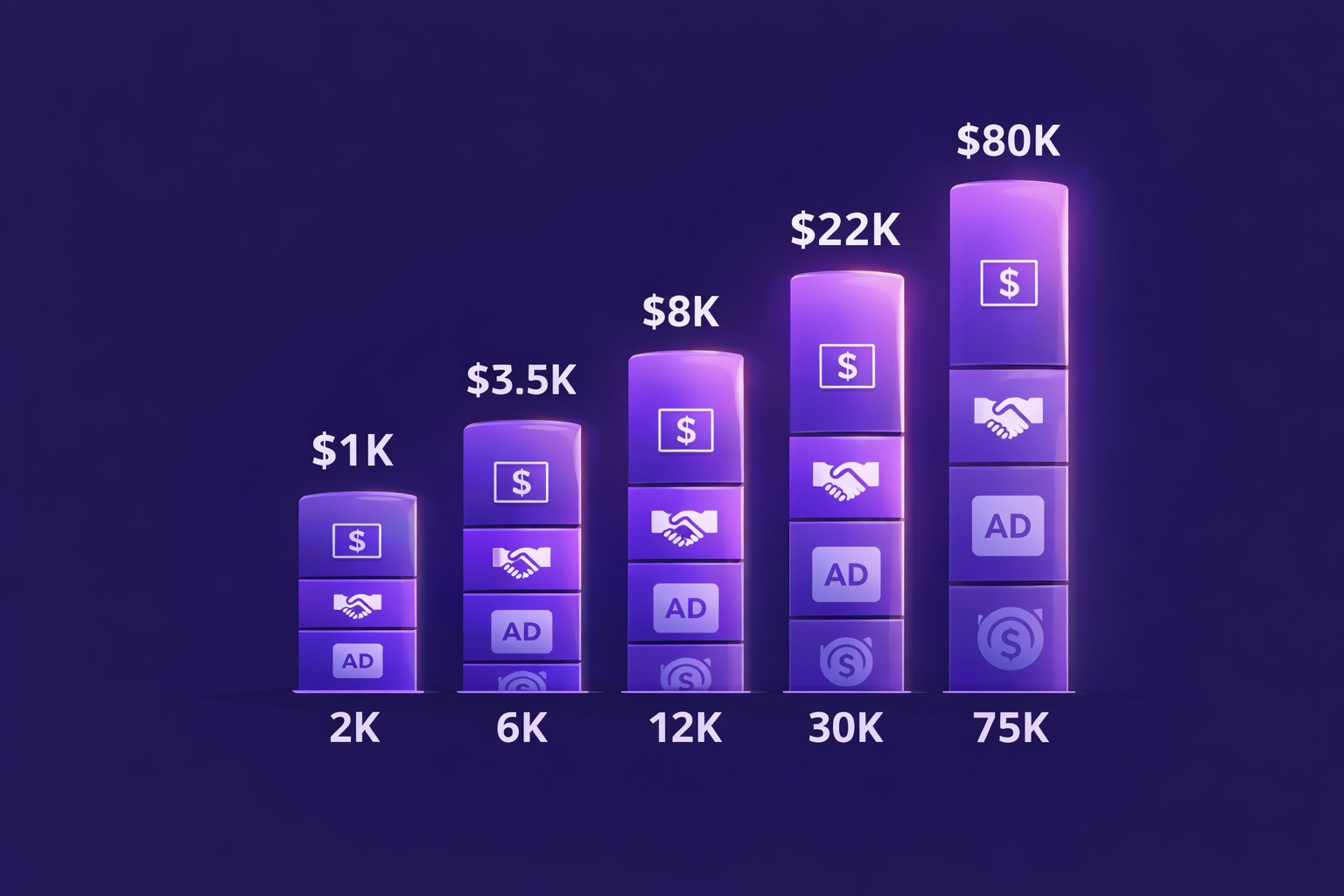
The real data that creators search for but can't find. 5 detailed income profiles at different subscriber tiers — from $1,000/month at 2,000 subscribers to $80,000/month at 75,000 — with full revenue breakdowns by source, time invested, platform used, and the one decision that mattered most at each stage.

The Creator Economy in 2026: Complete Guide to Email Monetization
The creator economy is now a $250B industry. Learn how successful creators are building $100K-$1M+ businesses through email monetization. Real data, revenue breakdowns, and actionable strategies for 2026.

How to Monetize Your Email List in 2026: 7 Proven Strategies for Content Creators
Turn your email list into a revenue-generating asset with these 7 proven monetization strategies. From programmatic ads to paid subscriptions, learn exactly how content creators are earning consistent income from their newsletters in 2026.

Newsletter Upsell Strategies: How to Sell Digital Products to Your Email Subscribers
Email converts digital product sales at 40x the rate of social media — yet most newsletter creators undermonetize because they upsell incorrectly. The complete architecture: the 7-email post-subscribe sequence that warms subscribers before the pitch, the four mid-issue CTA formats ranked by conversion rate, dedicated launch issue structure, product-type positioning for courses/templates/ebooks/coaching, segmentation-based upselling, and the non-buyer re-engagement approach that reaches subscribers on their own timeline.