Podcast Creators: How to Build an Email List and Turn Listeners into Revenue
Podcast listeners give you hours of their attention — the warmest audience in the creator economy. Yet 90% of podcasters let that relationship die when the episode ends. The complete podcast-to-email funnel: 5 conversion entry points, show notes strategy, lead magnets that work for audio audiences, and what 5,000 podcast email subscribers is actually worth.
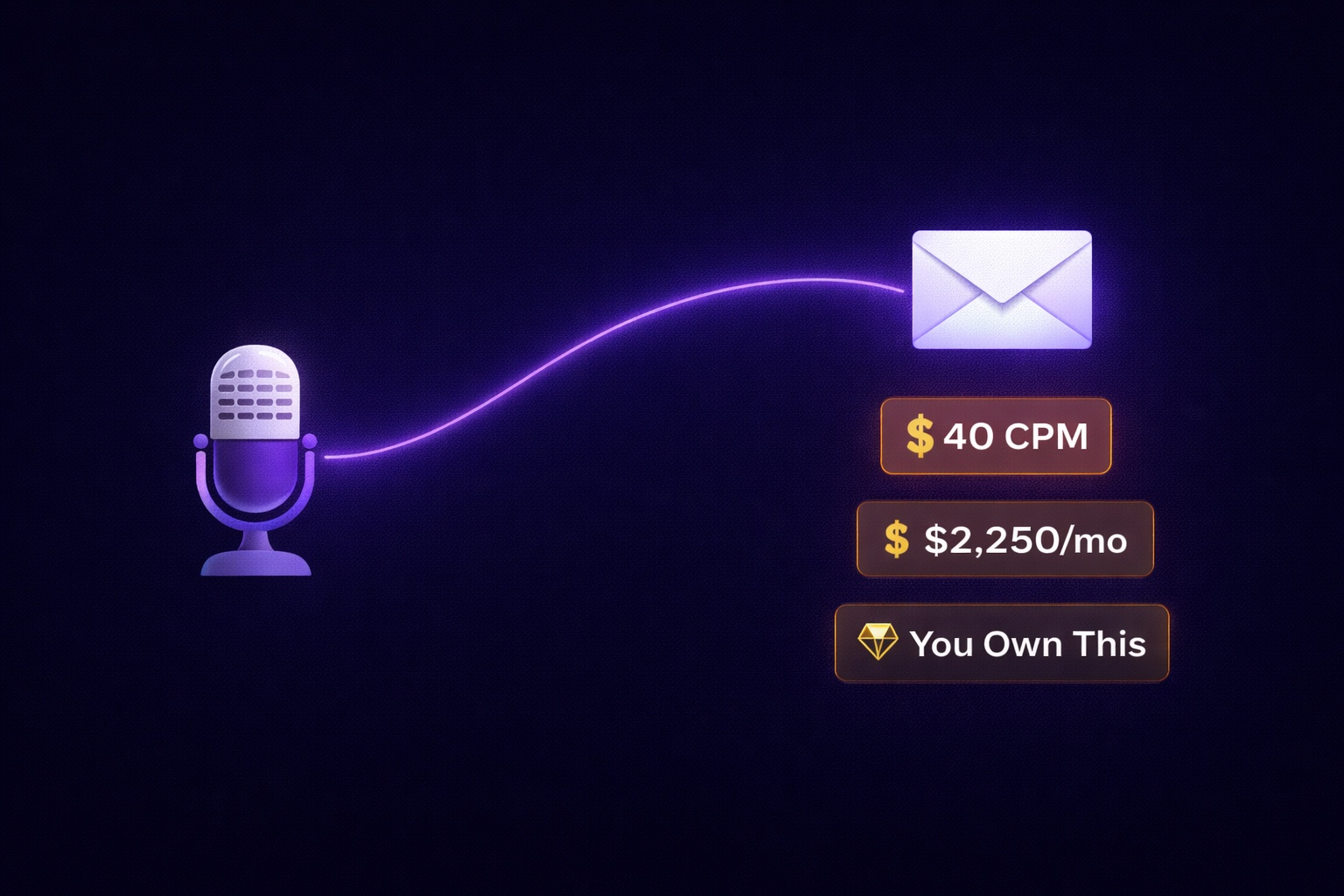
Think about what a podcast listener has given you. They've handed over their most personal piece of real estate — their ears and their time — while doing something else they care about. Commuting, exercising, cooking dinner. They weren't scrolling a feed and accidentally paused on your content. They actively chose to press play. Then they did it again the next episode. And the one after that.
A podcast listener who has consumed 10 episodes with you has spent 5-8 hours with your voice in their head. That's a depth of relationship that no YouTube viewer, Instagram follower, or Twitter reader comes close to matching. It's the warmest audience in the creator economy.
And 90% of podcasters let it die when the episode ends.
No email list. No newsletter. No way to reach those listeners directly when Spotify changes its algorithm, when Apple Podcasts shuffles its recommendations, when the RSS feed disappears from a hosting platform. The audience exists — hundreds, thousands, potentially tens of thousands of genuinely warm relationships — and there's no owned channel to reach them.
This guide is about fixing that. The podcast-to-email conversion funnel that works at every stage, the show notes strategy that turns every episode into a subscriber magnet, the lead magnets that podcast audiences respond to specifically, and the monetization stack that makes 1,000 email subscribers worth more than 50,000 podcast downloads.
Why Your Podcast Audience Is Your Most Valuable (and Most Wasted) Asset
Podcast downloads are a reach metric. Email subscribers are a relationship metric. The difference matters enormously when it comes to both monetization and audience resilience.
The hard comparison: 50,000 downloads vs. 1,000 email subscribers
50,000 monthly podcast downloads:
- Mid-roll ad CPM: $18-25 → $900-1,250/episode in ad revenue (one sponsor)
- Reachability: Zero. You can't contact listeners directly.
- Platform dependency: Entirely. Spotify, Apple, and the RSS ecosystem control distribution.
- Audience data: Limited. You know download counts, app used, country. That's nearly it.
1,000 email subscribers (engaged, from podcast):
- Programmatic ad revenue at $40 CPM (creator niche): $40/issue
- Direct sponsorship at $50 CPM: $50/issue — delivered to a known, reachable audience
- Paid subscription at $8/month, 5% conversion: $400/month recurring
- Reachability: Complete. You own the list, you can reach them anytime.
- Platform dependency: Zero. You hold the subscriber data regardless of what platforms do.
- Audience data: Deep. Engagement scores, open rates, click behavior, segmentation by interest.
At meaningful scale, these revenue streams converge and the email list wins on resilience, ownership, and monetization depth. The 50K downloads gets you more raw ad revenue — but it's entirely dependent on platform continuation and has no owned relationship you can build on.
The goal isn't to replace your podcast with a newsletter. It's to use your podcast as the top of a funnel that flows into an owned channel you control — and then monetize both layers simultaneously.
The Podcast-to-Email Conversion Funnel: 5 Entry Points
Podcast listeners don't convert to email subscribers automatically. They need specific prompts, at specific moments, tied to specific value. Here are the five highest-converting entry points — most podcasters use one or two; the best use all five.
Entry Point 1: The In-Episode CTA (Most Important)
A clear, single verbal CTA within the episode itself — not a laundry list of places to follow you, but one specific ask tied to specific value. "If you want the complete resource guide I mentioned with all the tools and the template we discussed, go to [simple URL] and I'll send it directly to your inbox."
What makes it work:
- One CTA, not three competing asks
- Specific value tied to what was discussed in the episode — not generic newsletter promotion
- Simple URL that's easy to remember while driving or exercising (use a short, memorable URL that redirects to your landing page — e.g., yourpodcast.com/guide)
- Timing: mid-episode after a high-value moment, or at the end before sign-off — not opening minutes before trust is established
Entry Point 2: Show Notes Lead Magnet
Every episode show notes page should include a prominent email capture form offering the episode's companion resource. Listeners who click through to show notes are already more engaged than average — they want more. Convert that intent into a subscription. More on this in the show notes section below.
Entry Point 3: Podcast Platform Profile Links
Spotify allows a link in your podcast profile. Apple Podcasts shows your website URL. Most podcasters link to their homepage — which typically converts at 1-3%. Link instead to your newsletter landing page or your best lead magnet page — the conversion rate on the same traffic typically jumps to 12-25%.
Entry Point 4: Guest Episode Cross-Promotion
When you appear as a guest on other podcasts, your verbal CTA should point to your newsletter signup page, not your podcast feed. Podcast listeners already know how to find other podcasts — what they don't have is your email list. Redirect the cross-promotion traffic to the channel you own.
Entry Point 5: Episode-Specific Landing Pages
For your most popular episode topics or recurring series, create a dedicated landing page that captures email addresses in exchange for the "complete companion resource" for that episode series. Link to this page in social promotion of the episodes. Listeners arriving from social with specific interest in a topic convert at much higher rates than general newsletter sign-up pages.
Your Show Notes Strategy: Turn Every Episode Into a Subscriber Magnet
Show notes are one of the most underused podcast growth assets. Most creators treat them as a formality — a quick episode summary with timestamps and guest links. The podcasters building serious email lists treat show notes as a standalone SEO content piece and a dedicated subscriber capture page.
The high-converting show notes structure:
- Episode-specific headline with keyword: "How [Guest Name] Built a $2M Newsletter Business From a 10K Podcast Audience" — not "Episode 47: Interview with [Guest Name]"
- Email capture form with episode-specific lead magnet above the fold: The most prominent element on the page, before the episode summary or timestamps. "Get the complete resource list from this episode delivered to your inbox."
- Episode summary with key insights: 300-500 words expanding on the episode's most valuable points — written for someone who found the page via Google, not just for existing listeners
- Timestamps with descriptive labels: Not just "00:04:23 — Topic discussion" but "00:04:23 — Why the first 1,000 email subscribers matter more than 50,000 downloads". Each timestamp is a micro-SEO opportunity.
- Resource section with links: Every tool, book, website, or framework mentioned in the episode — this section drives the most search traffic because people Google the specific things you mentioned
- Second email capture at bottom: For visitors who read through everything, a second opportunity to subscribe while the episode's value is fresh in their mind
The SEO opportunity most podcasters miss:
Well-written show notes rank on Google. A podcast episode about "how to start a newsletter" won't appear in search results. A show notes page titled "How to Start a Newsletter: A Step-by-Step Guide for Creators (Based on Our Interview with [Expert])" with 800+ words of substantive content absolutely can. Every episode is a potential SEO page bringing new visitors who've never heard your podcast — and converting them to subscribers.
Lead Magnets That Work for Podcast Audiences
Podcast audiences respond to specific lead magnet formats differently than blog readers or social media followers. They've consumed information in audio form — they're used to depth, not brevity. They're also often consuming while mobile, which shapes what they'll actually use.
Lead magnets with the highest conversion for podcast audiences:
- Episode companion resource: Everything referenced in the episode, organized and expanded — tools, templates, frameworks, links. Listeners who engaged with the episode already want more of exactly that content. Conversion rate: 15-30%.
- "Best of" episode compilation: Your top 5-10 episodes on a specific topic, curated with a brief summary and key takeaway from each. New listeners who discovered you through one episode and want to go deeper are ideal candidates. Conversion rate: 12-20%.
- Podcast-exclusive transcript with bonus content: The full transcript of your most popular episode, formatted readably, with bonus commentary or additional context not in the audio. "Read everything I said in the episode — plus what I couldn't say on mic." Conversion rate: 10-18%.
- Guest expertise compilation: If your podcast features guests, a "best insights from 12 months of interviews — distilled into one document" works extremely well. You're leveraging the credibility of every guest you've had simultaneously.
- The action toolkit: A template, checklist, or calculator that implements the main framework from your most popular episode. Listeners who are inspired by an episode but don't know how to act on it get the tool that closes that gap. Conversion rate: 18-28%.
What to Send: Newsletter Content Podcast Audiences Actually Want
The biggest mistake podcasters make with newsletters: treating the newsletter as a transcript or summary of the podcast. If subscribers wanted to re-consume the episode, they'd re-listen. The newsletter needs to be a distinct, complementary experience — not a text version of what they already heard.
The 4 newsletter formats that work best for podcast audiences:
Format 1: Behind-the-Mic (Most popular with podcast audiences)
What didn't make it into the episode. The context behind the interview — why you booked this guest, what surprised you in the pre-interview, the thing they said off-mic that you wish had been recorded. This is genuinely exclusive content that can't be experienced any other way.
Format 2: The Deeper Dive
One concept from the episode, explored in writing at a depth that audio doesn't allow. An episode about pricing strategy can mention it in 8 minutes. A newsletter can show a complete framework with worked examples, data references, and implementation steps that would take 40 minutes in audio and 8 minutes to read.
Format 3: The Subscriber-Exclusive Bonus
Content that is referenced in the episode but only delivered via the newsletter. "In this episode I mentioned the 5-step framework — subscribers get the full worksheet in today's newsletter." This creates a recurring incentive to both listen to the episode AND open the newsletter.
Format 4: The Preview
Subscribers get advance notice of upcoming episodes, guest previews, or topic teasers before they go live. Podcast audiences who feel like insiders — people who get information before regular listeners — are more loyal and more likely to share both the podcast and the newsletter.
Monetizing Your Podcast Newsletter: 4 Revenue Streams
The economics of a podcast newsletter stack differently than a pure newsletter or a pure podcast. The audience depth from podcast listenership means podcast-to-email subscribers typically have higher engagement and higher conversion rates than cold newsletter subscribers — which translates directly into higher revenue per subscriber.
Revenue Stream 1: Programmatic Newsletter Ads
The most passive revenue stream. Enabled from day one in InfluencersKit regardless of subscriber count. At $20-50 CPM depending on niche, 2,000 email subscribers generates $40-100 per issue from programmatic ads alone — revenue that doesn't exist in the podcast itself at that size.
Revenue Stream 2: Newsletter Sponsorships
Podcast sponsors who pay for mid-rolls (reaching a broad, passive audience) are often willing to pay a premium for newsletter sponsorships (reaching an audience that actively reads and clicks). Your newsletter sponsorship rates should reflect the higher engagement rates podcast-to-email audiences bring. At $50-75 CPM with 5,000 email subscribers: $250-375 per sponsored issue.
Revenue Stream 3: Paid Subscriptions
Podcast audiences convert to paid newsletter tiers at higher rates than cold email audiences — because the trust and relationship depth are already there. A paid tier offering deeper episode analysis, exclusive Q&As, or access to a community of podcast listeners can realistically convert 5-10% of your email list at $8-15/month. At 5,000 email subscribers with 7% paid conversion at $10/month: $3,500/month in recurring subscription revenue.
Revenue Stream 4: Affiliate Marketing and Products
Podcast audiences trust your recommendations deeply — you've earned that trust through hours of audio. This trust transfers directly to email. Affiliate recommendations that feel natural in newsletter context (tools you use, books you mention, services you recommend) convert at 2-5x higher rates from podcast-to-email subscribers than from cold newsletter audiences. And if you create a digital product — course, template, guide, membership — your podcast-fed email list is the highest-converting sales channel you have.
Real Numbers: What 5,000 Podcast Email Subscribers Is Worth
Conservative monthly revenue estimate (5,000 subscribers, podcast niche, weekly newsletter):
- Programmatic ads (4 issues × $30 CPM): $600/month
- Direct sponsorship (1-2 per month × $200 average): $200-400/month
- Paid subscriptions (5% conversion at $9/month): $2,250/month
- Affiliate revenue (modest, 1-2 recommendations per month): $100-300/month
- Conservative total: $3,150-3,550/month from 5,000 email subscribers
Compare to podcast-only at the same audience:
A podcast with 5,000 regular listeners (not downloads) — roughly 25,000-50,000 monthly downloads depending on episode frequency — might generate $500-1,500/month from podcast sponsorships alone, with no owned channel and complete platform dependency.
The multiplier effect:
Both channels running simultaneously — podcast as discovery and trust-building, newsletter as monetization and direct relationship — generate significantly more than either channel alone. The podcast builds the relationship. The newsletter converts it into revenue you own.
Your 30-Day Podcast Email Launch Plan
Week 1 — Foundation:
- Set up InfluencersKit account and configure your newsletter settings
- Create your first lead magnet — start with your most popular episode's companion resource (2-4 hours to create)
- Build your newsletter landing page with the lead magnet as the CTA
- Create a short redirect URL pointing to your landing page (yourpodcast.com/newsletter or similar)
- Write your 7-email welcome sequence — the most important automation you'll build
Week 2 — Integration:
- Update your podcast platform profiles (Spotify, Apple) to link to your landing page, not your homepage
- Re-record or update your standard episode CTA to promote the newsletter with specific value
- Update your 5 most popular episode show notes with an email capture form and companion resource
- Add newsletter link to your guest bio for future podcast appearances
Week 3 — Launch:
- Announce your newsletter in a dedicated episode — explain what subscribers get, what makes it different from just listening to the podcast, and why it's worth signing up
- Send the episode to your existing audience via any channels you have (social, Discord, community)
- Set a specific subscriber goal for the launch (100 subscribers in 30 days is achievable for most podcasts)
- Enable programmatic ads — start earning from every issue immediately
Week 4 — Optimize:
- Review landing page conversion rate — aim for 15%+ before driving more traffic
- Check welcome sequence open rates — Email 1 should be 60%+
- Update show notes for new episodes with the full high-converting structure
- Review which podcast CTA wording drove the most clicks and refine for future episodes
The podcast-to-email transition mirrors what YouTube creators and Instagram creators have found: the platform builds the audience, but the email list is where the monetization and resilience live. The sooner you build that owned channel, the sooner every new listener becomes part of a relationship you control. Build it now. Your future self will be grateful you didn't wait for 50,000 downloads.
Turn Your Podcast Listeners Into a Revenue Engine You Own
InfluencersKit is built for exactly this: converting a podcast audience into an email list that generates programmatic ad revenue, sponsorships, and paid subscriptions — all from one platform. Lead magnet delivery, landing pages, welcome sequences, and analytics included. No patchwork of tools needed.
Start your free trial — set up your podcast newsletter funnel this week and start building the channel you own.
Stay Updated
Get the latest insights, strategies, and tips delivered directly to your inbox. Join thousands of creators who are building their email communities with our weekly newsletter.
No spam, unsubscribe at any time. We respect your privacy.
Related Articles

Instagram Creators: How to Turn Your Followers into Email Subscribers (+ Monetize)
Instagram followers are worth $3-8. Email subscribers? $50-200. Learn the exact system to convert your Instagram audience to email and multiply your creator revenue 2-3x.

How to Build an Email List as a Fitness Creator: From Followers to Owned Audience
A fitness creator with 80,000 Instagram followers generates $800–$2,400/month from brand deals. The same creator with 4,000 email subscribers generates $3,000–$8,000/month — from one-twentieth the audience size. Lead magnets that convert fitness followers, platform-specific tactics for Instagram, TikTok and YouTube, newsletter content strategy, and the full monetization stack for fitness email lists.

Newsletter Reactivation: How to Win Back Inactive Subscribers (With Templates)
Every newsletter has inactive subscribers silently dragging down deliverability. A well-designed reactivation campaign recovers 8–20% of them while identifying the truly unrecoverable. The four-part reactivation sequence, subject lines that break through inbox habituation, the list hygiene logic that improves metrics after removal, and the onboarding system that prevents inactivity from accumulating in the first place.

Newsletter Strategy for Course Creators: Build Your List, Warm Your Audience, Fill Your Program
Course sales require the deepest trust of any creator product. Email is the only channel that builds that trust systematically. The complete system: lead magnets that pre-qualify students, a 10-email welcome sequence designed for enrollment, inter-launch content strategy, launch sequence framework, post-launch re-engagement, and evergreen enrollment system.