How to Build an Email List as a Fitness Creator: From Followers to Owned Audience
A fitness creator with 80,000 Instagram followers generates $800–$2,400/month from brand deals. The same creator with 4,000 email subscribers generates $3,000–$8,000/month — from one-twentieth the audience size. Lead magnets that convert fitness followers, platform-specific tactics for Instagram, TikTok and YouTube, newsletter content strategy, and the full monetization stack for fitness email lists.

Fitness creators have a platform distribution problem that makes their situation structurally different from almost every other creator category. Their content lives on Instagram, TikTok, and YouTube — platforms built to showcase physical transformation, movement, and visual demonstration. This content performs exceptionally on those platforms. But those platforms cannot deliver the personalised, consistent, trust-rich communication that converts a fitness follower into a paying client, a course buyer, or a supplement affiliate commission. That conversion requires email, and most fitness creators have barely started building the email infrastructure that would make their social media following commercially viable.
The economics make this gap costly. A fitness creator with 80,000 Instagram followers earning $0.01–$0.03 per follower per month from brand deals generates $800–$2,400/month. That same creator with 4,000 email subscribers running a well-monetized newsletter — programmatic ads, direct sponsorships, affiliate commissions on supplements and equipment, and a paid tier — generates $3,000–$8,000/month from a list one-twentieth the size. The leverage ratio for email versus social media in fitness is not marginal. It is the difference between a platform-dependent side income and a creator business that generates predictable monthly revenue independently of Instagram's algorithm or TikTok's reach variability.
This guide is the complete email list building system for fitness creators: the lead magnets that convert fitness followers into email subscribers at high rates, the platform-specific conversion strategies for Instagram, TikTok, and YouTube, the newsletter content strategy that maintains the relationship between your content and your audience across platforms, and the monetization stack that makes your email list the most commercially productive asset in your fitness business.
Why Fitness Creators Are Uniquely Well-Positioned for Email
Fitness audiences have three characteristics that make them exceptionally valuable as email subscribers compared to general lifestyle or entertainment audiences. First, they have high commercial intent — people who follow fitness creators are typically trying to achieve something specific (lose weight, build muscle, improve performance, learn to cook healthier) and are actively looking for products, programmes, and services that help them get there. This intent translates directly into higher affiliate conversion rates, more receptive audiences for product recommendations, and stronger paid tier conversion than general interest audiences.
Second, fitness content has natural recurrence needs — unlike a single purchase category, fitness is a sustained practice where subscribers need new workouts, new recipes, new protocols, and new content regularly. This creates a newsletter reading habit that is easier to establish and harder to break than many other categories. A subscriber who has been following your training methodology for six months does not stop being interested in your next workout programme or nutrition approach.
Third, fitness audiences have demonstrated willingness to pay for quality content. The online fitness industry — courses, coaching, meal plans, programmes — is one of the highest-converting content categories in the creator economy. Fitness creators with email lists that demonstrate their methodology, build trust in their expertise, and show real results from real people are selling into an audience that has already decided to invest money in their fitness. The email list is the mechanism that converts that investment intention into purchase action directed at you specifically rather than at a competitor.
Lead Magnets for Fitness Creators: What Actually Converts
The fitness creator category has a lead magnet advantage: the practical, tangible, immediately useful resource is the norm rather than the exception. A PDF workout plan, a meal prep guide, a macro calculator, a recipe collection — all of these are the exact format of content that fitness audiences seek out and value enough to exchange their email address for. The challenge is not finding a format that works; it is finding the specific positioning within that format that attracts your ideal subscriber profile rather than the broadest possible fitness audience.
Lead magnet formats with high conversion rates for fitness creators:
- The specific training plan (not a generic programme): "My exact 4-week programme for building visible shoulders — the plan I used to go from flat to rounded delts." The specificity and personal framing is the conversion driver. Audiences follow fitness creators because they trust their specific approach and want access to the actual protocols that creator uses, not generic beginner programmes. A specific, named plan that sounds like something you have personally done converts at 2–4x the rate of a "beginner workout programme."
- The macro or nutrition framework: A simple, immediately usable guide that subscribers can apply to their own situation — not a generic meal plan (which does not fit most people's food preferences or schedule) but a framework or calculator that produces personalised numbers. "My simple TDEE-based macro calculator — fill in your details and get your personalised targets." Nutrition guidance consistently produces the highest lead magnet conversion rates in fitness because it addresses the most universal question (what should I eat?) with a personalised output.
- The recipe collection, curated and specific: Not 100 healthy recipes but a tightly edited collection oriented around a specific approach: "My 14 highest-protein, lowest-prep meals — what I actually eat every week." The curation and personal framing are the value. Subscribers are not looking for a generic recipe book; they are looking for what you eat, because they trust your results.
- The protocol or challenge: A time-limited challenge structure with daily guidance — "7-day morning mobility challenge, 10 minutes per day" or "14-day nutrition reset, daily check-in prompts" — that provides a structured starting point for subscribers who want to take action immediately. Challenge formats convert well for fitness because they provide a clear, finite commitment rather than an open-ended subscription to general information.
- The guide to a common mistake: "Why most people never build visible abs — the 3 things you are doing wrong and how to fix them." This format converts well because it specifically addresses a pain point and signals that you have a diagnosis that most sources miss. Subscribers who already know they are stuck and have tried generic advice respond strongly to the promise of a specific, corrective perspective.
The lead magnet strategy guide covers the full creation and delivery mechanics. For fitness creators specifically, the delivery experience matters: a PDF that is well-designed, clearly structured, and genuinely practical creates a positive first impression that the newsletter must then live up to. A poorly produced lead magnet — generic stock images, dense unreadable text, no practical application — undermines the trust you have built through your social content before the email relationship has even begun. Invest in the visual quality of your fitness lead magnets in proportion to the visual quality of your social content.
Instagram to Email: Converting Your Most Visual Audience
Instagram is the dominant platform for fitness creator discovery and the primary source of email subscribers for most fitness-focused newsletters. The conversion path from Instagram to email is well-trodden but consistently underoptimised by most fitness creators because they focus on content quality (which is strong) without investing equivalent attention in conversion infrastructure.
The Instagram to email funnel has four leverage points: the bio link, the Stories CTA, post caption mentions, and direct message flows. Most fitness creators use only the first — a bio link to a general website or Linktree — and wonder why Instagram does not drive meaningful email signups. The conversion is in the specificity and frequency of the asks, not in the existence of a link.
Instagram conversion mechanics for fitness creators:
- Bio link optimisation: Link directly to your lead magnet landing page, not your website homepage or a multi-link page. One destination, one action. "Free 4-week programme ↓" in your bio description, linking to a dedicated landing page that delivers the specific resource, converts at 3–5x the rate of linking to a general website. Change your bio link to match whichever lead magnet you are currently promoting most heavily.
- Stories CTA cadence: Mention your newsletter or lead magnet in Stories 2–3 times per week. Not every Story — that trains your audience to skip those Stories — but with enough frequency that your active Story viewers encounter the CTA regularly. Specific Stories CTAs ("I just sent this week's training plan to my email list — link in bio to grab it") consistently outperform generic ones ("sign up for my newsletter").
- Caption mentions on relevant posts: When you post a workout video or nutrition post that relates to your lead magnet, mention the resource in the caption. "If you want the full 4-week programme this is from, it's free — link in bio." This contextual mention converts viewers who are already engaged with the specific content type into email subscribers at higher rates than non-contextual bio mentions.
- DM automation for comments: Ask viewers to comment a specific keyword ("Comment PLAN and I'll send you the full programme") and use automation to DM the lead magnet link to everyone who comments. Comment-to-DM funnels generate 15–30% conversion rates from comment to email subscription — dramatically higher than passive bio link clicks. The comment funnel strategy covered for TikTok applies equally to Instagram Reels.
The Instagram to email conversion guide covers the full system for creators who use Instagram as their primary platform. The key principle that applies specifically to fitness creators is that your Instagram content is demonstrating your results and methodology visually — so the email CTA should extend that demonstration into a tangible resource rather than simply asking followers to "stay in touch." Tie every email CTA to a specific, practical resource that extends the value of the Instagram content they are currently watching.
TikTok to Email for Fitness Creators
TikTok's fitness creator community is among the most active and fastest-growing on the platform, with fitness content reliably generating above-average reach and engagement compared to most other categories. The challenge for email conversion from TikTok is the same challenge every creator faces: one clickable link, an audience trained for fast content consumption, and no direct content-to-subscribe pathway. The advantage fitness creators have is that their content is inherently results-oriented — transformation content, progress updates, "what I eat in a day" videos, and training demonstrations are all content types where the implicit question in the viewer's mind ("how do I do that?") has a specific answer that can be delivered via email.
For TikTok fitness creators, the comment-to-DM funnel is the highest-conversion email acquisition tactic available. A video demonstrating a specific training technique, meal prep method, or transformation result ends with "Comment SEND and I'll DM you my exact programme/meal plan/guide." This works because the comment is prompted by a specific piece of content that has already generated viewer interest, the keyword is simple and actionable, and the promised resource directly extends the value of the video the viewer just watched. Conversion rates from these funnels for fitness content consistently run 20–35% from comment to email subscription because the intent selectivity is high — only viewers who want the specific resource will comment.
The bio optimisation principles from the TikTok email list building guide apply fully to fitness creators: lead with the specific resource rather than the generic newsletter, use a direct URL to a mobile-optimised landing page, and make the bio CTA specific to the content you are currently producing most. A fitness creator whose recent TikToks are all about high-protein meals should have their bio pointing to a high-protein recipe guide, not a generic newsletter sign-up page.
YouTube to Email for Fitness Creators
YouTube is the highest-quality subscriber source for fitness creators who use it, because the extended format allows for genuine expertise demonstration in a way that short-form content cannot. A viewer who watches a 20-minute workout tutorial and then a 15-minute nutrition breakdown has already spent 35 minutes with you — they have evaluated your knowledge, decided you know what you are talking about, and are now the warmest possible prospect for your email list. The conversion path from YouTube to email is short for an already-convinced viewer; the challenge is making the conversion infrastructure visible enough that they actually take the step.
The email list CTA in YouTube content should appear in three places: verbally in the video (ideally mid-video when engagement is highest, not just at the end), in the end screen with a clickable subscribe button pointing to your landing page, and in the video description with a prominent link in the first two lines (visible without expanding). The description link is particularly important because it is accessible to viewers who found the video through search and are reading the description to evaluate whether to watch — these viewers are in the highest-intent research mode and convert at above-average rates to email subscribers. The YouTube creator email strategy covers the full mechanics for channels of every size.
Newsletter Content Strategy: What Fitness Subscribers Want to Read
The fitness newsletter content challenge is bridging the gap between visual, demonstration-based social content and the text-forward format of email. Most fitness creators who start newsletters try to replicate their social content in email — they describe workouts, post recipe ingredients, and reference transformation content — and find that the format does not translate. Email is the place for the thinking and depth behind the content, not the content itself.
The newsletter content that performs best for fitness creators operates on a deeper level than the social content that attracted their subscribers. Your Instagram shows the workout; your newsletter explains the physiological rationale behind the exercise selection, the periodisation logic, and the common mistakes that prevent results. Your TikTok shows "what I eat in a day"; your newsletter explains the macronutrient reasoning, how you adjusted it based on feedback from your body, and the specific products or preparation methods that make the approach sustainable.
High-performing newsletter content types for fitness creators:
- The training log and reasoning: What you actually trained this week, what you were trying to achieve, what worked and what did not. Not a prescription for your audience but an honest account of your own practice. Authenticity about your own process — including mistakes, plateaus, and adjustments — builds deeper trust than aspirational perfection-focused content.
- The science translation issue: Take a recently published study or a piece of conventional fitness wisdom and examine whether the evidence actually supports it. Fitness is full of beliefs that are confidently stated but weakly supported. Being the creator who consistently engages with the actual evidence rather than repeating orthodoxy creates a distinctive authority position.
- The seasonal strategy issue: Fitness has natural temporal rhythms — the new year reset, the summer preparation period, the post-summer continuation challenge, the holiday navigation period. Newsletters that address these rhythms specifically, with actionable guidance for the moment subscribers are actually in, perform better than year-round generic content.
- The community spotlight: Feature a subscriber's result, challenge, or story. Ask subscribers to share progress photos or updates, select one per issue, and write a brief profile of their situation, what they tried, and what happened. This creates a community dynamic, social proof of real results from real people in your audience, and a powerful motivation signal for subscribers who are still working toward their own goals.
- The protocol review: A detailed breakdown of a specific approach — a training method, a nutrition protocol, a recovery strategy — with your honest evaluation of who it works for, who it does not, and what the evidence shows. Differentiated, specific opinions are more shareable and more trust-building than generic advice that hedges every statement.
Publishing weekly is the right frequency for most fitness newsletters. The seasonal content calendar that fitness creators benefit from is built around the natural cycles of the fitness year — peak motivation periods (January, spring, late summer), plateau periods (February, post-summer), and holiday-adjacent periods (November/December) when subscribers need different support than they do during high-motivation periods. The 52-week content calendar system is easily adapted for a fitness creator's seasonal rhythms.
Segmentation for Fitness Newsletters
Fitness audiences are not monolithic. A subscriber who followed you for weight training content has different interests and needs than one who found you through your running content. A subscriber trying to lose 30 pounds is in a fundamentally different situation than one trying to add 10 pounds of muscle. Sending the same content to both subscribers — as most fitness newsletters do — reduces relevance for both, which suppresses open rates and makes monetization harder because you cannot direct relevant product or programme recommendations to the right audience segments.
The segmentation framework for fitness newsletters starts with the lead magnet — if you have multiple lead magnets for different fitness goals, the lead magnet a subscriber downloaded tells you which goal they are pursuing and allows you to tag them accordingly from day one. Supplement this with a brief onboarding survey (2–3 questions in your welcome sequence) asking about their primary goal, current training experience level, and biggest challenge. These three data points allow you to send meaningfully different content to your strength training audience versus your weight loss audience versus your endurance audience — and to direct product recommendations and programme launches to the subscribers for whom they are most relevant.
Monetizing Your Fitness Email List
Fitness is one of the highest-revenue categories for newsletter monetization because the audience has high commercial intent and the product landscape is rich. The most productive monetization stack for fitness creators combines multiple streams that operate simultaneously.
Affiliate marketing is the most immediately accessible monetization channel, and fitness has exceptional affiliate programme economics. Supplement companies — protein, pre-workout, vitamins, specialty nutrition products — typically pay 10–20% commissions on products with high repeat purchase rates (protein and daily supplements are consumed and reordered monthly). Athletic apparel brands with affiliate programmes pay 5–10% on high average order values. Equipment companies pay 5–15% on purchases that range from $50 to $500+. A fitness newsletter with 1,000 engaged subscribers recommending 3–4 products per month at these commission rates can generate $500–$2,000/month in affiliate income without any sponsor relationships or product creation. The affiliate marketing system for newsletter creators covers the recurring commission model that compounds this income over time.
Direct sponsorships are available to fitness newsletters much earlier than most fitness creators realise. Supplement brands, fitness app companies, meal kit services, and athletic equipment companies all have marketing budgets specifically for fitness creator audiences and regularly sponsor newsletters with 500–5,000 engaged subscribers in the right demographic. The sponsorship rate card guide covers how to price fitness newsletter sponsorships at smaller subscriber counts where CPM-based pricing understates your audience's commercial value.
Digital products are the highest-margin revenue stream for fitness creators once their email list provides the launch infrastructure. A training programme, a nutrition guide, a coaching curriculum, a recipe collection with accompanying meal plans — these are products that fitness audiences have proven willingness to pay for, that your newsletter has been implicitly demonstrating the quality of with every issue, and that your email list provides a distribution channel for without any advertising spend. The small newsletter monetization guide covers exactly how to pre-validate and launch digital products to lists under 1,000 subscribers before investing significant production time.
A paid newsletter tier makes most sense for fitness creators whose content has a strong intelligence or coaching component — regular protocol updates, personalised Q&A, community coaching — rather than pure inspiration and general information. A paid tier priced at $15–$20/month providing weekly personal training guidance, meal plan frameworks, or accountability community access converts at meaningful rates from fitness audiences who are already spending $30–$150/month on gym memberships and supplements and are actively seeking better guidance. Build your free newsletter to the point where 1,000+ subscribers are opening consistently before launching a paid tier, and use the referral programme to accelerate the list growth that makes the paid tier launch viable.
Growing Your Fitness Email List Beyond Social Media
Social media is the natural starting point for fitness creator list building, but the most successful fitness newsletter operators also build subscriber acquisition channels that operate independently of their social following. SEO-driven organic traffic from fitness content — "how to build a home gym," "what to eat before a workout," "best exercises for [muscle group]" — generates subscribers who are actively searching for information and are therefore in high-intent research mode. These subscribers convert to email subscribers at above-average rates because they found you through a specific question, and your lead magnet provides a specific answer.
Podcast guesting is particularly effective for fitness creators because long-form audio allows for the kind of methodological depth that short-form video cannot accommodate. A 40-minute podcast conversation where you explain your training philosophy, share your own results, and give genuinely novel tactical advice generates subscribers who have already evaluated your expertise comprehensively before they ever visit your sign-up page. These are warm-to-hot prospects who convert at high rates and whose long-term engagement and purchase rates exceed those from cold social media discovery.
Newsletter cross-promotions with adjacent fitness creators — complementary niches like nutrition, mindset, performance, recovery, or specific sports — generate high-quality subscribers from audiences that have already demonstrated the fitness interest and email-subscriber commitment that predicts long-term engagement. A strength training newsletter cross-promoting with a sports nutrition newsletter reaches an audience that is already both fitness-oriented and accustomed to reading newsletter content — the ideal profile for a new fitness subscriber.
The Fitness Newsletter Flywheel: How Each Element Reinforces the Others
The fitness creator email business compounds in a way that makes the upfront investment in building it disproportionately valuable over time. The mechanism works as follows: strong social content attracts new subscribers to your email list. Your lead magnet converts those followers at high rates by addressing a specific fitness goal they are actively pursuing. Your welcome sequence establishes the trust relationship and introduces your methodology. Your ongoing newsletter maintains that trust through genuinely useful, specific, personality-driven content. Your monetization stack — affiliate commissions, sponsorships, digital products, paid tier — generates revenue from that trust relationship. The revenue funds better content production, stronger lead magnets, and occasionally paid advertising to accelerate list growth. The growing list generates more social proof, which attracts more social followers, which produces more email subscribers.
Breaking into this flywheel at any point works — you do not need to have all elements in place simultaneously. Most successful fitness newsletter operators start with one strong lead magnet and one conversion channel (typically Instagram or TikTok), establish a consistent weekly newsletter, and add monetization and growth elements sequentially over the first 6–12 months. The key discipline is not attempting to optimise every element at once before launching — the friction of waiting for everything to be perfect consistently delays fitness creators from building a list that would have been generating revenue much earlier if launched with a functional minimum viable version.
The fitness newsletter also has a distinctive seasonal opportunity that most other creator categories lack. Fitness has two peak motivation periods — January and the spring-to-summer transition — when audience acquisition costs are lower (higher organic reach on fitness content), lead magnet conversion rates are higher (more people actively pursuing fitness goals), and product launch performance is stronger (audiences are in decision-making mode about fitness investments). Building your list growth and launch infrastructure before these windows — in October/November for January, and in February/March for the spring-summer period — allows you to capitalise on the seasonal motivation surge rather than scrambling to set up systems during it. The content calendar framework that maps seasonal opportunities year-round makes this preparation systematic rather than ad hoc.
Finally, the fitness newsletter has a unique retention advantage that many other niches lack: the ongoing nature of fitness as a practice means subscribers do not "graduate" from needing your content. Unlike a business newsletter subscriber who eventually figures out the basics and no longer needs beginner-level guidance, a fitness subscriber continues to benefit from your newsletter as their goals evolve — from initial weight loss to body recomposition to performance improvement to maintenance — and as the science, the equipment, and the strategies continue to develop. This ongoing relevance means that a fitness newsletter subscriber retained for three years generates three years of monetization opportunity. Combined with a solid referral programme that turns satisfied long-term subscribers into audience ambassadors, the long-tenure fitness subscriber becomes one of your most valuable business assets.
Email Infrastructure Designed for Fitness Creator Businesses
InfluencersKit provides fitness creators with mobile-optimised sign-up pages, automated lead magnet delivery, goal-based subscriber segmentation, and the full monetization stack — affiliate link tracking, sponsorship management, programmatic ads, and paid tier support — all in one platform. Explore the list-building tools, the growth features, and the monetization suite before starting.
Start your free trial — build your fitness newsletter sign-up page in under 15 minutes and start converting your social following into subscribers you own.
Stay Updated
Get the latest insights, strategies, and tips delivered directly to your inbox. Join thousands of creators who are building their email communities with our weekly newsletter.
No spam, unsubscribe at any time. We respect your privacy.
Related Articles

Email Marketing for Etsy Sellers: Build a List That Outlasts the Algorithm
Etsy changed its algorithm in 2022, raised fees in 2023, and updated seller standards in 2024 — each time without warning. The only structural protection against marketplace dependency is building a direct customer relationship through email. How to legally collect subscribers as an Etsy seller, the lead magnets that attract buyers, the welcome sequence that drives repeat purchases, and the seasonal campaign structure that makes revenue predictable.
How TikTok Creators Build Email Lists That Survive Algorithm Changes
TikTok can suppress your reach overnight, ban your account, or get blocked in your country — and you lose every follower instantly. The 5 strategies TikTok creators use to convert followers into email subscribers they actually own: comment funnels, lead magnets built for mobile, live CTAs, and bio optimization that converts.
Twitter/X Creators: How to Convert Your Following into an Email List That Actually Pays
X Premium pays $0.003 per 1,000 views. A newsletter with 2,000 subscribers generates $1,000–1,500/month from ads, sponsorships, and a paid tier. The complete X-to-email flywheel — 6 conversion tactics, pinned post optimization, thread strategy, and the full revenue stack.
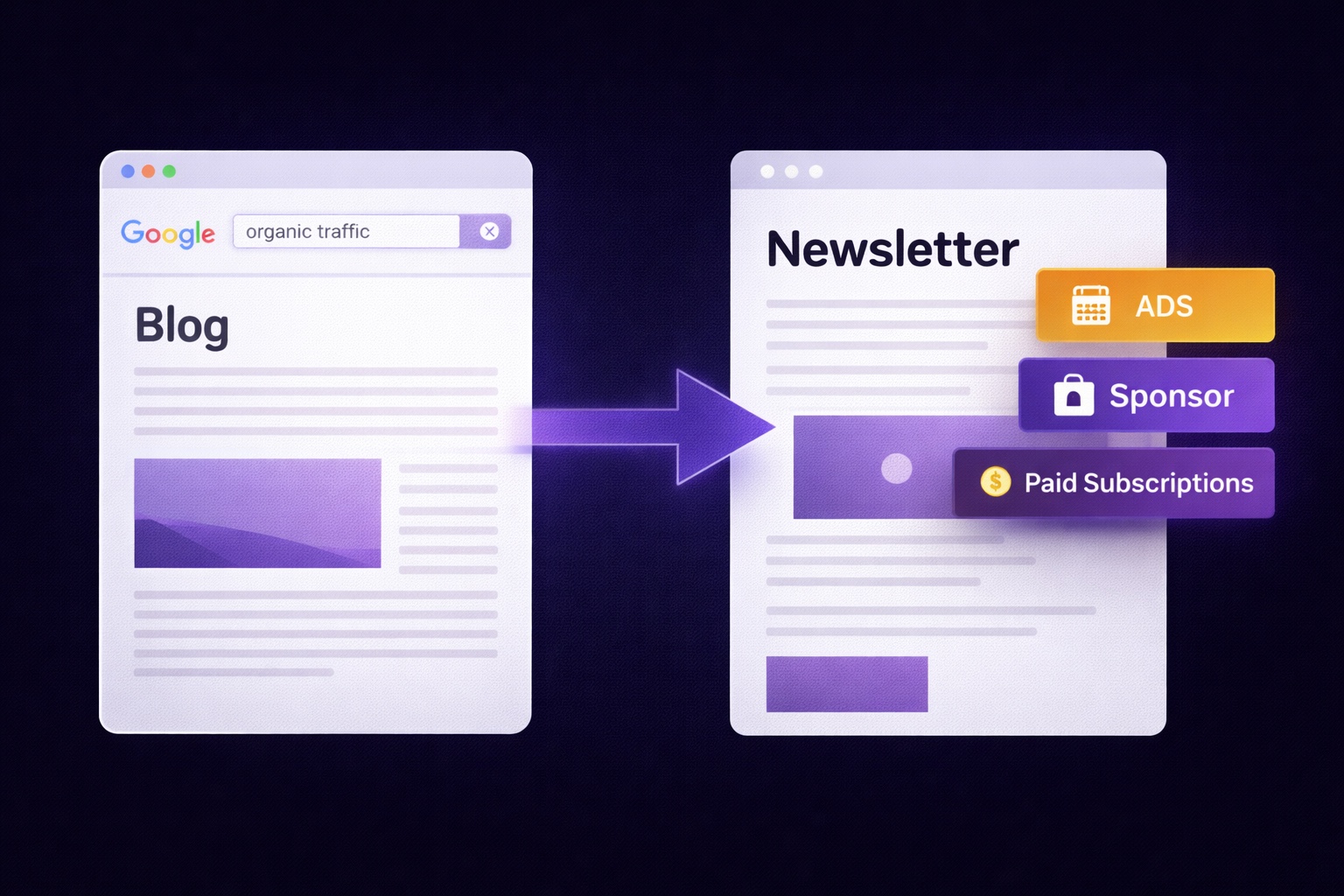
Bloggers & Writers: How to Turn Your Blog Into a $5,000+/Month Newsletter Business
Bloggers already have the hardest parts: proven content demand, warm traffic, and writing discipline. The step-by-step system to convert that foundation into a newsletter business — content upgrades that convert at 15-35%, migrating from Substack or Ghost, the SEO + newsletter flywheel, and 6 revenue streams that replace display ad income.