Newsletter Subject Lines: 85 Proven Templates That Get 40%+ Open Rates
Your subject line is the entire game in email. 85 tested templates across 7 categories — curiosity gaps, number-led, personal, contrarian, and more — with the psychology behind why each works and what to avoid.
You could write the best newsletter issue of your life this week. A piece so good that readers forward it to colleagues, reply to tell you it changed how they think, save it to re-read later. And none of that will happen if the subject line doesn't get them to open it.
The subject line is the entire game in email. Not a detail, not an afterthought — the whole thing. Average newsletters treat subject lines as the last 30 seconds of the publishing process. The best newsletter creators treat them as a separate craft that gets practiced, tested, and refined with the same rigor as the content itself.
This guide gives you 85 proven subject line templates organized by type and niche, the psychological framework behind why each type works, what kills open rates (including the spam trigger words you're probably using without realizing it), and how to A/B test your way to the formulas that work best for your specific audience.
Bookmark this one. Come back to it every time you sit down to write.
Why Subject Lines Are Your Single Biggest Open Rate Lever
The average person receives between 50 and 150 emails per day. They spend approximately 2 seconds deciding whether to open each one. In those 2 seconds, your subject line has to do one specific job: make opening this email feel more rewarding than moving on to the next one.
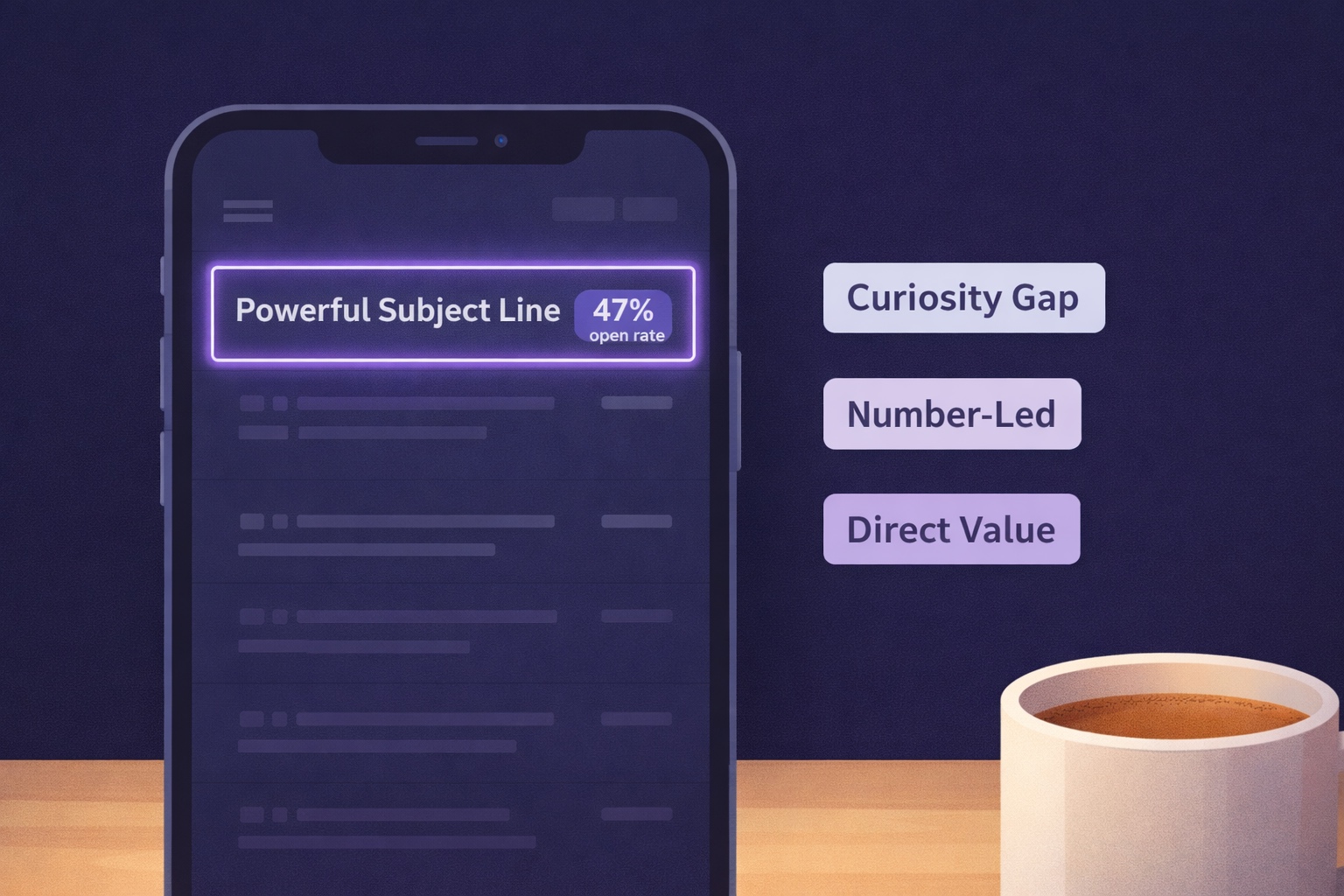
Open rates vary by 200-300% based on subject line alone, with all other variables controlled. The same newsletter content sent with a weak subject line versus a strong one can yield 19% opens versus 47% opens. That's not marginal — that's the difference between a newsletter that grows through word-of-mouth and one that quietly stagnates.
And open rates compound. Subscribers who consistently open your emails get trained by their inbox to expect value from you. Over time, your sender reputation improves, which improves deliverability, which improves open rates further. A strong subject line habit creates a flywheel that mediocre subject lines simply cannot.
The Psychology of "Why Did I Open This?"
Every high-performing subject line triggers one of six psychological responses. Understanding the mechanism behind each one lets you choose the right tool for each issue rather than guessing.
The 6 Open-Rate Drivers:
- Curiosity: An open loop the brain needs to close. "The thing I got wrong about open rates" — you cannot not want to know what that thing is.
- Self-interest: A clear, direct promise of value. "How to cut your newsletter production time in half" — there's something in it for the reader and it's obvious.
- Social proof: What others are doing or thinking validates attention. "What 500,000-subscriber newsletters have in common" implies authority and pattern.
- Specificity: Specific details signal credibility. "My newsletter went from 23% to 47% open rate in 6 weeks" is 3x more compelling than "How to improve your open rates."
- FOMO / Urgency: The fear of missing something relevant. "What's changing in email deliverability next month" creates urgency without a fake deadline.
- Personal connection: It feels like it came from a person, not a broadcast. "I almost didn't send this one" reads like a message from a friend.
The best subject lines often trigger two or three of these simultaneously. "The mistake I made with 4,000 subscribers that cost me $2,000" hits curiosity, specificity, and self-interest at once. That's why it outperforms any single-mechanism subject line.
85 Proven Subject Line Templates by Category
Category 1: Curiosity Gap Templates (14 templates)
These work by starting a thought without finishing it. Use when your content has a surprising finding, counterintuitive conclusion, or reveal that rewards the read.
- "The email that changed how I think about [topic]"
- "What I found after [specific action] (not what I expected)"
- "Why [common belief in your niche] is usually wrong"
- "The thing nobody tells you about [topic]"
- "I was wrong about [topic]. Here's what I actually think now."
- "What [impressive result] taught me about [broader topic]"
- "The reason [common problem] keeps happening (it's not what you think)"
- "What [well-known example] got right that everyone else missed"
- "The question I keep getting asked — and my honest answer"
- "After [time period], here's what I still can't explain"
- "The part of [topic] I never talk about publicly"
- "What happened when I tried [experiment]"
- "I changed my mind about [topic]. Here's why."
- "The advice everyone gives about [topic] that backfired on me"
Category 2: Number-Led Templates (13 templates)
Numbers create immediate structure in the reader's mind. They signal that you've done the work of organizing information. Odd numbers consistently outperform even numbers.
- "[N] things I wish I knew before starting a newsletter"
- "The [N] emails that drive 80% of my revenue"
- "[N] tools I use every week (and the [N] I dropped)"
- "[N] ways to [desirable outcome] — ranked by effort vs. impact"
- "I analyzed [N] newsletters with [metric]. Here's what they share."
- "[N]-minute read: everything you need to know about [topic]"
- "My top [N] [content type] from this month"
- "[N] questions I asked [authority/type of person] about [topic]"
- "The [N] metrics that actually predict newsletter success"
- "[N] [niche] strategies, ranked from worst to best"
- "[N] red flags that your [thing] needs to change"
- "After [N] newsletters: what changed, what didn't"
- "[N] things working right now in [niche] (data from [N] creators)"
Category 3: Direct Value Promise Templates (12 templates)
No mystery — just a clear promise of what the reader gets. Best for how-to content, tutorials, and subscribers earlier in their relationship with you who need to see value before they commit to opening.
- "How to [achieve specific outcome] in [time frame]"
- "The exact [process/template/framework] I use for [task]"
- "Step-by-step: [specific task] without [common pain point]"
- "Your guide to [topic] — updated for [year]"
- "How I [achieved result] (and how you can replicate it)"
- "The [adjective] guide to [topic] for [specific audience]"
- "Everything you need to [outcome] — in one email"
- "How to fix [specific problem] in under [time]"
- "The framework I use to [achieve result] every time"
- "Your [topic] cheat sheet (save this one)"
- "A step-by-step breakdown of [impressive/interesting process]"
- "How to [do thing] the right way (not the way everyone teaches it)"
Category 4: Personal and Conversational Templates (12 templates)
These feel like messages from a person, not a newsletter broadcast. They work best once you have an established relationship with your audience. Overuse makes them feel manipulative; used sparingly, they're extremely high-converting.
- "Quick question for you"
- "Can I be honest about something?"
- "I almost didn't send this one"
- "You asked about this — here's my full answer"
- "Something I've been thinking about all week"
- "A [day of week] thought before you start your week"
- "What I'm doing differently this [time period]"
- "Real talk: [topic]"
- "This one's a bit different from my usual"
- "Something happened this week I need to tell you about"
- "My honest take on [recent event or trend in niche]"
- "[First name] — wanted to share this with you"
Category 5: Counterintuitive and Contrarian Templates (10 templates)
Challenge your audience's existing beliefs. This is the hardest category to execute well because the content must actually deliver on the provocation. Fail to back it up and you lose trust. Nail it and you become memorable.
- "[Widely accepted belief] is wrong. Here's the data."
- "Stop [commonly recommended action]. Do this instead."
- "The [common tactic] everyone uses that quietly destroys [metric]"
- "Why [popular thing] isn't worth [common investment] for most [audience]"
- "Unpopular opinion: [contrarian take on topic]"
- "The advice I'd give my past self (it's not what you'd expect)"
- "What [conventional wisdom] gets wrong about [topic]"
- "I tried [popular approach] for [time period]. Here's what actually happened."
- "The [metric/thing] everyone optimizes for that doesn't actually matter"
- "Why [appealing thing] is usually a trap (and what to do instead)"
Category 6: Social Proof and Data Templates (10 templates)
Credibility through numbers, research, and other people's experience. Especially effective in niches where data-driven decision-making is valued.
- "What [N] creators with [large audiences] have in common"
- "Data from [N] newsletters: what's actually working in [year]"
- "[Creator type] earning $[amount]/month share their strategies"
- "The [metric] benchmarks for [niche] newsletters in [year]"
- "What the most-forwarded newsletters do differently (analysis of [N])"
- "[Research/study] says [finding]. Here's what it means for [audience]."
- "Why the top [N]% of [niche] newsletters do [counterintuitive thing]"
- "[N] creators share their best [topic] strategies (their actual numbers)"
- "The [adjective] [niche] newsletter playbook — drawn from [N] real examples"
- "What happened to [N] creators who tried [strategy] (real results)"
Category 7: FOMO and Timely Templates (10 templates)
Create urgency around developments, trends, or time-sensitive information. Use in moderation — maximum 1 in 5 issues — or the urgency stops registering.
- "What's changing in [niche] [next month/this quarter] — and how to prepare"
- "Before everyone else catches on to this [trend/strategy]"
- "This is happening in [niche] right now. Most people haven't noticed."
- "The [trend/opportunity] window is closing — here's how to use it"
- "What's happening in [niche] this week (and what to do about it)"
- "[Platform/tool/regulation] is changing [date]. Here's what it means for you."
- "While everyone debates [topic], the smart play is [action]"
- "This [trend] is 18 months old in [adjacent niche] — it's just reaching ours"
- "The [thing] everyone will be talking about next quarter"
- "Act on this before it becomes saturated: [opportunity]"
Subject Line Length, Emoji Use, and Preview Text
Length
The data on length:
- Under 30 characters: Often too vague to drive strong opens, unless paired with very high sender reputation (personal/"Quick question" style)
- 30-50 characters: The mobile sweet spot. Displays fully on most phones. Best for personal and direct-value formulas.
- 50-70 characters: The desktop sweet spot. Room for specificity and curiosity. Best for number-led and counterintuitive formulas.
- 70+ characters: Gets truncated on mobile (50%+ of email opens are mobile). If you're over 70, front-load your most important information — the cut-off should happen at a natural pause, not mid-phrase.
Practical rule: Write your subject line, then check it at 50 characters. If it makes sense and creates interest at 50 characters, you're fine.
Emoji in Subject Lines
When emoji work:
- Lifestyle, fashion, food, wellness niches — casual audiences expect visual elements
- Used at the end or beginning (not buried mid-subject)
- When the emoji adds meaning, not decoration (✅ for checklists, 📊 for data, 🧵 for threads)
- Sparingly — one emoji per subject line maximum
When emoji hurt:
- B2B, finance, legal, medical niches — professional audiences lose trust
- Multiple emoji in one subject line — looks like spam
- Emoji that don't render consistently across email clients (can display as squares)
Practical rule: If you'd use emoji in a text message to your ideal subscriber, use them. If you wouldn't, don't.
Preview Text: Your Second Subject Line
Preview text (the grey text that appears next to or below your subject line in the inbox) is used by fewer than 30% of newsletter creators. This is a missed opportunity. Readers see subject line + preview text together in their inbox. They work as a unit.
How to use preview text strategically:
- Extend the curiosity gap: Subject: "I was wrong about open rates" → Preview: "Here's the data that changed my thinking — and what I'm doing differently now"
- Amplify the value promise: Subject: "5 newsletter tools I use every week" → Preview: "One of them cut my writing time by 40%. All are free."
- Add social proof: Subject: "What 50K-subscriber newsletters have in common" → Preview: "I analyzed 30 of them so you don't have to"
- Create urgency: Subject: "The deliverability change coming in March" → Preview: "This affects every newsletter creator — here's how to prepare before it hits"
If you don't set preview text manually, your email client will pull the first line of your email body — which is often a formatting element, greeting, or unsubscribe text. Always set it manually.
What Triggers Spam Filters (The Words to Avoid)
Words and phrases that damage deliverability and open rates:
Financial / promotional red flags:
- Free, Free!, FREE (especially in all-caps or with exclamation)
- Cash, money, earn money, make money, income
- Discount, offer, deal, save, % off, limited time
- Act now, don't miss, last chance, expires
- Guaranteed, promise, risk-free
Formatting that triggers spam:
- ALL CAPS (anywhere in subject line)
- Excessive punctuation!!!!! or ???
- Multiple exclamation marks
- Dollar signs ($$$)
- Re: or Fwd: when it's not actually a reply/forward
The nuance:
These words don't automatically send your email to spam — modern spam filters are more sophisticated than simple keyword matching. But they do reduce deliverability scores, especially in combination or when your sender reputation isn't strong yet. Avoid them in subject lines as a habit, especially early in your newsletter's life.
Strong subject lines work together with good deliverability. If your emails are landing in promotions or spam, open rates suffer regardless of how good your subject line is. Review our complete guide to email deliverability to make sure your infrastructure is solid before optimizing subject lines further.
A/B Testing Your Subject Lines
The templates above are starting points, not answers. Your specific audience has its own preferences that you can only discover through testing. A/B testing subject lines is the most direct way to build a data set on what works for your readers.
How to run a valid subject line A/B test:
- Test one variable at a time: Compare curiosity vs. direct value (same content, different subject approach). Don't change format AND length AND emoji at once — you won't know what caused the difference
- Minimum sample size: 500+ subscribers per variant for statistically meaningful results. Below that, variance is too high to draw conclusions
- Test at the same time: Send variants simultaneously (split your list), not on different days or times
- Track over 48 hours: Some subscribers open within minutes; others check email once a day. Give both enough time before calling the winner
- Build a log: Keep a simple spreadsheet of every test, both variants, and the result. Patterns emerge over 10-15 tests that tell you which formulas your specific audience responds to
What to test systematically over 8 weeks:
- Week 1-2: Curiosity gap vs. direct value promise
- Week 3-4: Long vs. short (50 chars vs. 70+ chars)
- Week 5-6: Number-led vs. no numbers
- Week 7-8: Personal/conversational vs. informational
Use your analytics dashboard to run A/B tests and track open rate performance across issues. The best newsletter writers in any niche consistently test — it's the single habit that separates improving open rates from stagnating ones.
Pair strong subject lines with the newsletter formats and structures that keep readers reading once they open — because a high open rate on forgettable content trains readers to eventually stop opening. The subject line gets them in. The content keeps them there.
Test. Learn. Improve Every Issue.
InfluencersKit includes built-in A/B testing for subject lines, preview text, and send times — so you can systematically build the data set that tells you what your audience responds to. Combined with engagement analytics and subscriber scoring, you'll know not just your open rate, but which subscribers are most engaged and why.
Start your free trial and run your first subject line A/B test on your next issue.
Stay Updated
Get the latest insights, strategies, and tips delivered directly to your inbox. Join thousands of creators who are building their email communities with our weekly newsletter.
No spam, unsubscribe at any time. We respect your privacy.
Related Articles
How to Write a Newsletter People Actually Read: The Format That Gets 45%+ Open Rates
Two newsletters, same niche, same frequency — one gets 48% open rates, one bleeds subscribers. The gap is the writing. This covers the 4 formats that build loyal audiences, subject line formulas, the structure that holds attention, and the 4-hour workflow that keeps you consistent.

Newsletter Reactivation: How to Win Back Inactive Subscribers (With Templates)
Every newsletter has inactive subscribers silently dragging down deliverability. A well-designed reactivation campaign recovers 8–20% of them while identifying the truly unrecoverable. The four-part reactivation sequence, subject lines that break through inbox habituation, the list hygiene logic that improves metrics after removal, and the onboarding system that prevents inactivity from accumulating in the first place.

Newsletter Strategy for Course Creators: Build Your List, Warm Your Audience, Fill Your Program
Course sales require the deepest trust of any creator product. Email is the only channel that builds that trust systematically. The complete system: lead magnets that pre-qualify students, a 10-email welcome sequence designed for enrollment, inter-launch content strategy, launch sequence framework, post-launch re-engagement, and evergreen enrollment system.

Email Marketing for Online Coaches: Build Your List, Nurture Prospects, Fill Your Program
Coaching has a long sales cycle — clients need weeks of trust-building before they commit. Email is the only marketing channel that matches this cycle structurally. The complete system: how to build a list that attracts your ideal client profile, the 7-email welcome sequence that pre-qualifies prospects, and how to run enrollment conversations through email without feeling salesy.