Email Marketing for Etsy Sellers: Build a List That Outlasts the Algorithm
Etsy changed its algorithm in 2022, raised fees in 2023, and updated seller standards in 2024 — each time without warning. The only structural protection against marketplace dependency is building a direct customer relationship through email. How to legally collect subscribers as an Etsy seller, the lead magnets that attract buyers, the welcome sequence that drives repeat purchases, and the seasonal campaign structure that makes revenue predictable.
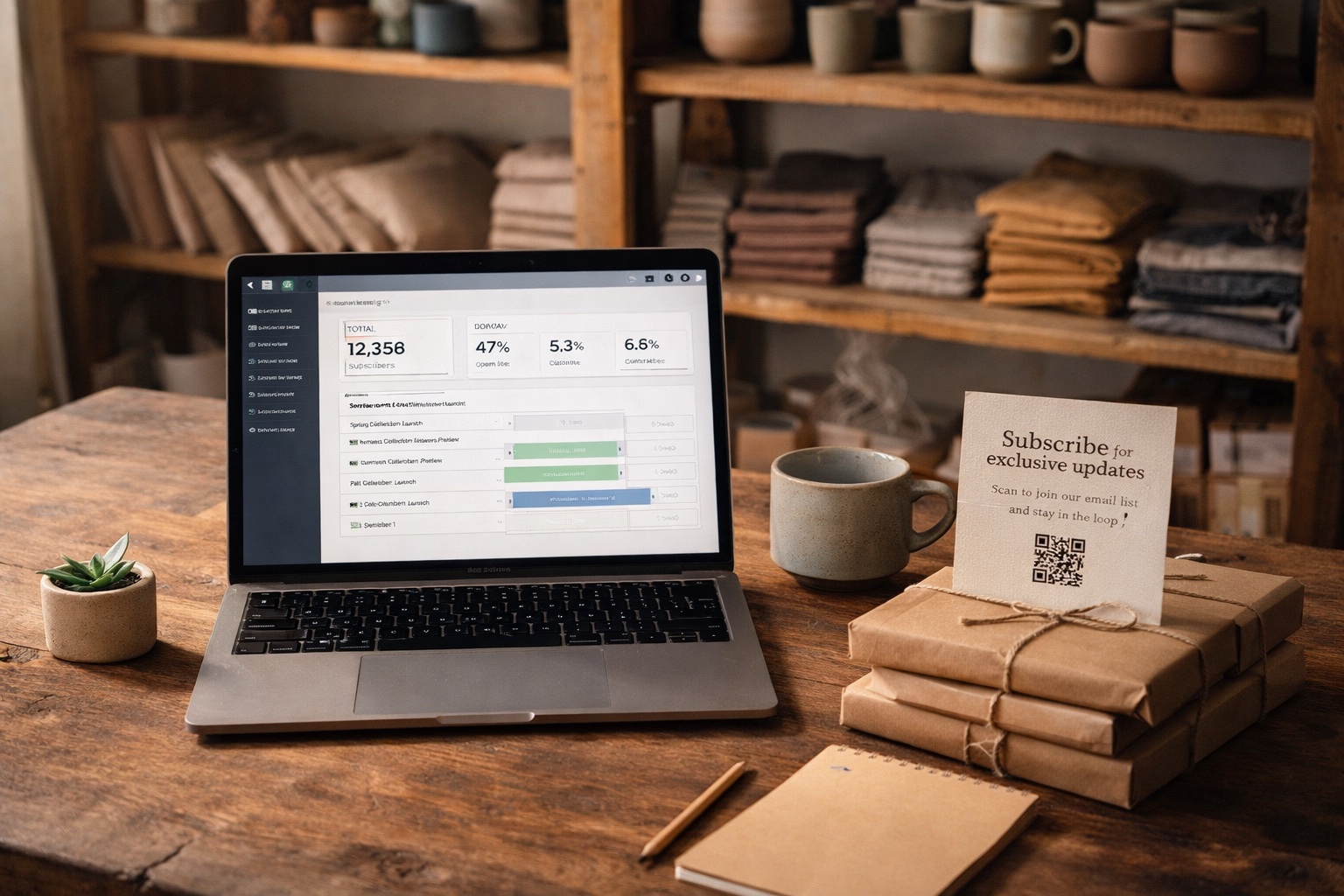
In 2022, Etsy changed its search algorithm without warning and thousands of sellers watched their monthly sales drop by 30–60% overnight. In 2023, the platform raised its transaction fee from 5% to 6.5%, reducing margins across every product category. In 2024, new seller standards restricted search visibility for shops that didn't meet updated fulfillment thresholds — regardless of product quality or customer satisfaction scores. Each of these changes shared one characteristic: sellers had no warning, no input, and no alternative. Comply or leave.
This is the structural risk of building a product business entirely on a marketplace platform. Etsy owns the customer relationship. Etsy decides who sees your products, what fees you pay, and what policies govern your operations. When the platform changes — and marketplaces always change — your business changes with it, whether or not the change serves your interests. The only structural protection against platform dependency is building a direct relationship with the customers who buy from you: their email addresses in your list, your updates arriving in their inbox without an algorithm deciding whether to show them.
Email marketing for Etsy sellers isn't a marketing tactic added on top of your Etsy business. It is the infrastructure that makes your business resilient — the owned customer relationship that exists independently of any marketplace's decisions. This guide covers the complete system: how to legally collect email subscribers as an Etsy seller, the lead magnets that attract the right audience, the welcome sequence that turns first-time browsers into returning customers, the newsletter content strategy that builds loyalty without reading like a product catalog, the seasonal campaign structure that drives predictable revenue spikes, and the repeat-purchase infrastructure that most Etsy sellers completely ignore.
The Etsy Email Problem: What the Platform Allows and What It Doesn't
Before anything else, a critical clarification that most email marketing guides for Etsy sellers skip: Etsy's terms of service explicitly prohibit sellers from taking buyer email addresses from order information and adding them to external marketing lists without the buyer's explicit, separate consent. When a customer purchases from your Etsy shop, their contact information is provided for the purpose of fulfilling that specific order — not for building your marketing database. Sellers who violate this policy risk account suspension, and it is a policy Etsy enforces.
This creates an apparent paradox: you have customers who have already bought from you, whose email addresses appear in your order records, but whom you legally cannot contact through external marketing without specific permission. The solution is not to work around Etsy's policy — it is to build the permission-based subscriber acquisition infrastructure that operates entirely within it.
What you can do within Etsy's terms: include a physical insert in product packaging that invites customers to subscribe to your newsletter at a specific URL or via QR code; include a message in your Etsy shop announcement directing visitors to subscribe for exclusive subscriber content; use Etsy's messaging system to follow up on orders for legitimate order-related purposes (shipping updates, care instructions, satisfaction follow-ups) and include, at the end of that legitimate communication, an invitation to subscribe for [specific subscriber benefit]. What you cannot do is take email addresses from order records and add them to your marketing list without a separate, explicit opt-in.
The list you build through legitimate subscriber acquisition belongs to you. It lives in your email platform, not in Etsy's database. It survives algorithm changes, fee increases, and policy shifts because the platform those subscribers are on is your own. Every subscriber you collect through ethical, permission-based acquisition is a customer relationship that Etsy cannot modify, restrict, or take away.
Lead Magnets That Work for Product-Based Businesses
The lead magnet — a free resource offered in exchange for an email subscription — is the highest-converting subscriber acquisition tool available to most businesses. For Etsy sellers, lead magnets need to be designed carefully: they should attract the specific customer who buys your products, not a general audience who will browse but never purchase. The most effective lead magnets for product sellers solve an adjacent problem to the product itself.
If you sell handmade candles, a free "Home Fragrance Layering Guide" attracts exactly the person who cares about home ambiance — the same person who buys a premium handmade candle. If you sell digital planners, a free single-page weekly planning template attracts planners who would purchase a more comprehensive premium planner. If you sell custom jewelry, a free "How to Style and Care for Your Jewelry" guide attracts jewelry enthusiasts who would buy custom pieces. The principle in each case: the lead magnet's topic reveals the subscriber's interest category, which is the same category your products occupy.
Lead magnet ideas by Etsy seller category:
- Home decor and candles: Seasonal home styling guide, room scent pairing guide, how to choose candle sizes for different spaces, a seasonal decorating colour palette.
- Digital products (planners, printables, templates): A free mini version of a paid planner, a single-page template from a larger set, a getting-started guide for the productivity or organisation system your products support.
- Handmade jewellery and accessories: Jewellery care guide, layering and styling guide, how to measure for custom sizing, a guide to different metal types and their properties.
- Art prints and wall decor: Gallery wall planning template, colour palette guide for different room styles, how to frame and hang artwork correctly, a room-by-room art styling guide.
- Craft supplies and kits: Beginner project guide for the specific craft, technique tutorial PDF, materials sourcing guide, a common-mistakes-and-how-to-fix-them reference.
- Wedding and event stationery: Stationery ordering timeline guide, invitation wording templates, assembly and mailing checklist, a guide to paper weights and printing options.
- Baby and kids products: Age-appropriate developmental activity guide, gift guide by age and stage, fabric care instructions and safety information guide.
- Vintage and curated goods: How to authenticate items in your specific category, guide to styling vintage in contemporary spaces, care and preservation guide for vintage textiles or ceramics.
The best lead magnet is one that a person who would buy your products finds genuinely useful — specific, practical, and directly relevant to the world your products inhabit. Generic lead magnets attract broad audiences. Product-adjacent lead magnets attract buyers.
Digital lead magnets have a specific advantage for product sellers: they can be delivered instantly, automatically, and at zero marginal cost regardless of how many subscribers join. A PDF guide, a printable template, or a video tutorial is set to deliver automatically the moment someone subscribes — no manual fulfillment, no delay, no per-unit cost. This scalability means your subscriber acquisition system can be as aggressive as you like without creating operational overhead. The lead magnet approach that works best for product sellers is one that pre-qualifies subscribers by interest area, making every subsequent email more relevant and more effective.
Building Your Subscriber Acquisition Infrastructure
Your email list grows through multiple acquisition channels, each serving a different audience entry point. For Etsy sellers, the most important channels are: a standalone website or landing page as the permanent destination for all subscription CTAs; your Etsy shop announcement and profile for reaching buyers actively browsing your shop; product packaging and inserts for reaching customers at the moment of maximum purchase satisfaction; and social media for reaching followers who know your brand but haven't yet subscribed.
The standalone subscription landing page deserves particular investment. A dedicated page for your newsletter subscription — separate from your Etsy shop — gives you an algorithm-independent destination for every marketing effort. A QR code on product packaging links here. Your Instagram bio links here. Your Pinterest pins link here. When someone discovers your brand through any channel, they have a destination that doesn't depend on Etsy's decisions about search ranking or shop display. This page should make the value of subscribing immediately obvious — what subscribers receive, how often, and what makes it worth their inbox space.
Product packaging inserts are the highest-converting subscriber acquisition tool available to physical product Etsy sellers. A customer who has just received your product and is pleased with it is in the ideal psychological state to subscribe: they trust your quality, they want to stay connected to your brand, and the subscription CTA arrives at the moment of maximum satisfaction. A simple, well-designed card with the message "Subscribe for [specific subscriber benefit] at [URL] or scan the code below" converts at 15–40% of customers who receive it — far higher than cold subscription CTAs through any other channel, because the customer has already demonstrated trust through purchase.
For digital product sellers on Etsy, the equivalent moment is the automated product delivery email — the message that delivers the purchased file. Including a subscription invitation in this message ("While you're here — I send [frequency] emails about [topic], including [specific subscriber benefit]. Subscribe here: [link]") captures buyers at the same moment of maximum trust and satisfaction. This touchpoint is consistently underused by digital Etsy sellers despite being one of their highest-converting subscriber acquisition opportunities.
The Welcome Sequence for Product Sellers
The welcome email sequence for a product-based business differs from a content creator's welcome sequence in one critical respect: the goal is not primarily to establish expert authority, but to establish a brand relationship. Subscribers who join through a product-adjacent lead magnet already know you make products — the welcome sequence deepens that relationship, introduces the full scope of your brand, and makes the subscription feel worthwhile from the first email.
A five-email welcome sequence for Etsy sellers:
- Email 1 (immediate): Deliver the lead magnet. Welcome warmly. One sentence about who you are and what you make. Set expectations clearly: "You'll hear from me [frequency] with [specific subscriber benefits]." No product pitch. Just a warm, professional first impression that delivers on the promise that got them to subscribe.
- Email 2 (Day 2–3): Your story. Why you make what you make, how it started, what drives the work. Etsy buyers are not buying from a corporation — they are buying from a person, and the decision to buy handmade or independent-seller products is partly a decision to support that person. The story that makes your products meaningful to you is the story that creates the emotional connection that drives repeat purchasing. Share it here, before any commercial content.
- Email 3 (Day 5): Behind the process. How your products are made — materials sourced, craftsmanship decisions, what distinguishes your approach from mass-produced alternatives. This content creates appreciation for craft that justifies your pricing and differentiates you from cheaper competitors. Subscribers who understand how something is made value it more than subscribers who see only the finished result.
- Email 4 (Day 7–8): The subscriber exclusive. Deliver the tangible benefit that makes the subscription actively valuable: a subscriber-only discount code for your Etsy shop, early access to a new collection, a subscriber-exclusive tutorial or styling guide, or first look at an upcoming product. This email delivers the reason to stay subscribed — and should do so with genuine value, not a generic coupon.
- Email 5 (Day 10–12): Social proof and product highlight. Share customer testimonials with specific detail (not generic five-star quotes, but feedback that describes the experience and outcome), photos of products in real customer settings, or the backstory of your best-selling product. End with a clear, low-pressure invitation to visit your shop or explore a specific collection. After this, subscribers enter your regular broadcast newsletter.
Newsletter Content Strategy: Not a Product Catalog
The most common newsletter mistake product businesses make is treating email as a product announcement channel. "New arrivals." "Shop our spring collection." "Stock is limited." These messages train subscribers to read your emails as advertisements — and advertisements get tuned out. Open rates decline, click rates drop, and subscribers who were initially engaged gradually stop engaging at all. The newsletter that reads like a curated email from someone whose creative world you find genuinely interesting retains subscribers and drives purchases. The newsletter that reads like a catalog loses both.
The newsletter content that keeps product-business subscribers engaged over months and years is content about the world the products inhabit. A candle maker who writes about creating different sensory experiences in different seasons, the psychology of scent memory, and how to transition a living space across the year is writing content that retains readers who care about home environment. Those same readers buy premium handmade candles. The editorial content and the product serve the same audience — the content just makes the relationship richer and more durable than a product announcement ever could.
Newsletter content categories that work for product sellers:
- Behind the process: How specific products are made, why materials are sourced where they are, what craftsmanship decisions go into each piece. This content justifies your pricing and creates the appreciation that differentiates your products from mass-produced alternatives at lower price points.
- Inspiration and styling: How to use your products, how to style them in different contexts, how to combine them with other elements in a space or an outfit. Content that helps subscribers envision your product in their own life is the most direct path from awareness to purchase.
- The making-of story: The origin story behind a specific product — what inspired it, what problem it solves, what aesthetic decisions shaped it. Stories create attachment to specific products that product listings and marketing copy alone cannot generate.
- Subscriber exclusives: First look at new collections before public launch, subscriber-only discount codes, early access to limited pieces, invitations to share input on upcoming designs. These exclusives make subscription actively valuable — subscribers who feel they have access that non-subscribers don't are the ones who stay subscribed longest and buy most consistently.
- Care and use guides: How to care for your products, how to extend their life, how to get the most from them over time. This content reduces returns, increases satisfaction, and generates repeat purchases from customers who feel supported after their initial purchase rather than abandoned once the transaction is complete.
- Seasonal content: What's relevant to your product category in the current season, how your products fit seasonal occasions, gift guides for upcoming holidays. Seasonal content has the highest natural purchase intent alignment of any format for product-based businesses.
The content ratio that works for most product-business newsletters is approximately two content-forward issues for every one product-forward issue. This means subscribers receive genuine editorial value — content they would read even if it contained no product mention — two-thirds of the time, which makes the one-third that promotes products feel like a trusted recommendation rather than routine advertising. The writing principles that build loyal newsletter audiences apply here just as they do for content creators: specificity, genuine value, and consistency are what sustain engagement over months and years.
Seasonal Campaign Planning for Etsy Sellers
Product businesses have a natural advantage in seasonal email marketing: the purchase occasions that drive most product-category sales happen on a predictable annual calendar. Valentine's Day, Mother's Day, back-to-school, Halloween, Thanksgiving, and Christmas create concentrated purchase intent in specific categories at predictable windows every year. Sellers who build email campaigns around these windows — starting earlier than the general market expects, with subscriber-exclusive early access — consistently outperform sellers who send a single promotional email the week before the holiday.
The effective seasonal campaign structure runs on four touchpoints, beginning six weeks before the occasion. This lead time feels excessive to sellers who are accustomed to last-minute promotions, but it serves two distinct audiences: early planners who want to secure custom or handmade items well before the occasion, and procrastinators who don't think about gifting until the deadline email arrives. Both groups exist in your subscriber base; the four-touchpoint structure captures both.
The four-touchpoint seasonal campaign framework:
- Six weeks before the occasion — Subscriber preview: "Our [holiday/occasion] collection is coming — as a subscriber, you're seeing it first." Share work-in-progress photos, describe what's being made and why, invite feedback on designs. No purchase CTA — pure exclusive access. This email creates anticipation and makes subscribers feel valued before any commercial ask arrives.
- Four weeks before — Early access launch: The collection goes live for subscribers 24–48 hours before the public launch. Subscriber discount code included. Subject line emphasises exclusivity explicitly: "Subscriber early access opens tonight." For custom or limited-edition products, this window matters practically — buyers who want specific pieces or custom options need to order early.
- Two weeks before — Social proof and urgency: Customer photos from prior seasons, highlights of best-selling pieces, clear mention of any quantity limitations. For custom or handmade products, reference the production timeline clearly and specifically: "Orders placed after [date] won't arrive before [occasion]." Vague urgency is ignored; specific production timelines are acted on.
- One week before — Last order date email: Short, direct, warm. Subject line references the deadline explicitly: "Last day for guaranteed [occasion] delivery." No new persuasion content — just the clear, friendly reminder and the shop link. Deadline emails capture the procrastinators who represent 30–40% of seasonal purchase volume but who need a specific, imminent deadline to act.
This four-email sequence consistently outperforms single promotional emails for seasonal launches. The early access exclusive creates genuine subscriber value; the last-order-date email captures procrastinators who respond to deadline, not to promotion.
Building the full-year seasonal content and campaign calendar in advance — identifying every seasonal occasion relevant to your product category and scheduling the four-touchpoint campaign for each — transforms seasonal email marketing from reactive to systematic. Reactive sellers create a promotion the week before Mother's Day. Systematic sellers have their Mother's Day campaign planned in February, their subscriber preview email scheduled for April, and their early-access launch ready to deploy in late April. The systematic seller's campaign starts earlier, generates more revenue from early planners, and is dramatically less stressful to execute.
Repeat Purchase Sequences: The Revenue Most Etsy Sellers Ignore
Etsy sellers focused on acquiring new customers consistently underinvest in repeat purchase marketing — which is where the most profitable customers live. A customer who has bought from you once has already overcome every barrier to purchase: they discovered you among thousands of competing sellers, evaluated your products, trusted your quality, and completed a transaction. Converting them to a second purchase is significantly easier and significantly less expensive than converting a new customer to a first purchase. Yet most Etsy sellers' marketing effort is directed almost entirely at new customer acquisition, leaving the repeat purchase relationship almost entirely to chance.
The repeat purchase sequence begins at the moment of first purchase. Customers who have bought from your Etsy shop (or who have indicated a purchase through your email platform) should enter an automated sequence designed to generate a second purchase through a combination of satisfaction support, complementary product introduction, and timely reorder prompting.
Two to three days after purchase, a product care or use guide email — not a promotional email, but a genuinely helpful message — helps the customer get the most from their new purchase. This reduces returns, builds satisfaction, and creates a positive brand association at the moment of highest product engagement. Three to four weeks after purchase, a curated complementary product recommendation: "Other customers who bought [their product] also love [complementary product], because [specific, genuine reason]." Frame this as a thoughtful recommendation, not a cross-sell, because that is what it should be — a genuinely useful suggestion to someone whose taste you now know.
For consumable products — candles, skincare, food products — an eight-to-ten-week reorder reminder catches customers just as their initial purchase is nearing the end. "Your [product] should be running low about now — grab another before your favourite [scent/colour/variety] sells out." This timing is not accidental; it is calibrated to the average consumption rate of the product. A well-timed reorder reminder generates repeat revenue at a fraction of the marketing cost of new customer acquisition, because it reaches a satisfied customer at the exact moment they naturally would need to repurchase.
Growing Your List Beyond Etsy Buyers
Etsy buyers are the most qualified audience for your newsletter, but building an email list exclusively from past customers limits your growth to your purchase volume. The fastest-growing product-business newsletters build subscriber acquisition systems that reach potential customers before they've purchased — converting brand discoverers into subscribers, then subscribers into customers through the welcome sequence and regular newsletter.
Pinterest is the highest-ROI subscriber acquisition channel for most product-based Etsy sellers because the platform's visual nature aligns with product discovery, and every pin links to an external URL — including your subscription landing page. A pin titled "Free Guide: [Topic relevant to your product category]" generates both brand discovery and list growth simultaneously. Unlike Instagram, which restricts external links to the bio, every Pinterest pin can link directly to your subscription page, making it genuinely effective for driving subscriber acquisition rather than just follower growth.
The referral program is particularly effective for product businesses because purchases create natural recommendation moments. A customer who loved what they received wants to share it — incentivising them to refer friends who might love your products creates a word-of-mouth acquisition channel that is both cost-efficient and highly pre-qualified. Referred subscribers from existing customers share the referring customer's taste profile and purchasing behaviour, making them among the highest-converting new subscribers you can acquire.
Content marketing through a blog or Pinterest-optimised content creates a long-term organic subscriber acquisition system that compounds over time. A handmade pottery seller who publishes content about table setting, ceramic care, and different clay body types will attract exactly the audience interested in handmade pottery — and can convert that traffic to subscribers with a relevant lead magnet embedded in each piece. Posts and pins created today continue generating subscribers two and three years from now without additional effort. This compounding is the defining advantage of content-driven acquisition over paid acquisition, which stops the moment you stop paying.
Segmentation for Product Sellers
The most useful segmentation categories for product businesses align with purchase behaviour and demonstrated product interest: what someone has purchased or expressed interest in, how recently they purchased, and whether they are a first-time or repeat buyer. These segments enable meaningfully different communication — a first-time buyer needs a different nurture sequence than a loyal repeat customer who has bought twelve times; someone who purchased from your jewellery collection needs different follow-up content than someone who bought your home accessories.
Interest-based segmentation developed through lead magnet topic, link click behaviour, and self-reported preferences allows you to send product announcements to the subscribers most likely to care about them. A new jewellery collection announcement sent to all subscribers generates lower engagement and purchase rates than the same announcement sent specifically to subscribers who clicked your jewellery content links or subscribed through your jewellery-adjacent lead magnet. Segmentation for product businesses is structurally simpler than for content businesses — you are segmenting by product interest rather than content topic preference — but the conversion impact is equally significant. The principle is the same in both contexts: relevant messages outperform generic messages at every stage of the subscriber relationship.
Metrics That Matter for Etsy Seller Email Marketing
The metrics that tell you whether your email marketing is working are different for product businesses than for information businesses. Open rates and click rates indicate subscriber engagement — but the metric that matters for a product business is revenue per subscriber: total email-attributable revenue divided by subscriber count. A subscriber who opens every issue but never purchases contributes less commercial value than a subscriber who opens occasionally but purchases twice a year.
Revenue attribution for Etsy sellers requires UTM parameters on every link to your shop — URL tracking codes that identify which email drove the traffic that converted to a sale. These take twenty minutes to implement and make your email marketing measurable in the way that matters: not how many people opened the email, but how much the email generated in sales. Most email platforms support UTM parameters natively; applying them consistently to every shop link transforms your reporting from audience metrics to revenue metrics.
Repeat purchase rate — the percentage of customers who make a second purchase within a defined period — is the retention metric that email marketing most directly affects. Sellers running effective post-purchase sequences and a consistent newsletter see repeat purchase rates of 25–40%. Sellers with no email marketing see rates of 8–12% — customers who return only if they happen to remember and search for your shop. The gap between these rates, expressed in dollars per retained customer, is the direct commercial value of your email marketing investment. Even a small, well-managed list produces meaningful revenue when the retention metrics are strong: 500 subscribers with a 30% repeat purchase rate generating an average $65 per repeat purchase represents $9,750 in annual repeat revenue — from a list that costs almost nothing to maintain once the sequences are built.
Platform Considerations: What Etsy Sellers Should Look For
Etsy sellers evaluating email platforms should prioritise: automation capabilities for post-purchase and welcome sequences; lead magnet delivery automation that runs without manual fulfillment; segmentation tools for purchase-history-based targeting; clear analytics that surface revenue attributable to email campaigns; and pricing that scales predictably as the list grows without creating surprise cost jumps that make list building feel financially risky.
The platform decision matters less than the strategy implemented on it — but choosing a platform that won't limit your capabilities as you grow avoids a migration later that carries operational overhead and potential subscriber attrition. Platforms that restrict automation on lower-tier plans, limit segmentation capabilities until you reach higher pricing tiers, or require separate tools for revenue tracking increase both the cost and complexity of running an effective email program. The free vs. paid platform question for product businesses is answered by whether the tools that make email commercially productive are included or require external additions. A free plan that prevents you from building the automation sequences that generate repeat purchases is not actually free — it's costing you the revenue those sequences would generate. Evaluating the broader platform landscape with creator monetization use cases in mind provides more relevant guidance than general email platform reviews optimised for enterprise marketing teams.
Your Customer Relationship Shouldn't Depend on Etsy's Algorithm
Every subscriber you collect legitimately is a customer relationship that survives fee increases, algorithm changes, and policy updates. The automation sequences that drive repeat purchases, the seasonal campaigns that create predictable revenue spikes, the welcome sequence that turns first-time buyers into returning customers — these are the infrastructure of a product business that doesn't depend on any marketplace's decisions. Explore the list-building tools, growth automation, and revenue tracking that make email marketing genuinely measurable for product businesses. See the full pricing — the Starter plan is free.
Start building your list today — your first 1,000 subscribers on the free plan.
Stay Updated
Get the latest insights, strategies, and tips delivered directly to your inbox. Join thousands of creators who are building their email communities with our weekly newsletter.
No spam, unsubscribe at any time. We respect your privacy.
Related Articles

Newsletter Upsell Strategies: How to Sell Digital Products to Your Email Subscribers
Email converts digital product sales at 40x the rate of social media — yet most newsletter creators undermonetize because they upsell incorrectly. The complete architecture: the 7-email post-subscribe sequence that warms subscribers before the pitch, the four mid-issue CTA formats ranked by conversion rate, dedicated launch issue structure, product-type positioning for courses/templates/ebooks/coaching, segmentation-based upselling, and the non-buyer re-engagement approach that reaches subscribers on their own timeline.
How to Create a Paid Membership Newsletter: Tiers, Pricing, and Content Strategy
Paid newsletters generate revenue that compounds with every subscriber and is immune to algorithm changes. The complete framework: pricing that reflects actual content value, the free-to-paid content split that converts without giving everything away, founding member launch mechanics, retention systems that reduce churn, and the platform fee math that decides how much you actually keep.

How to Build an Email List as a Fitness Creator: From Followers to Owned Audience
A fitness creator with 80,000 Instagram followers generates $800–$2,400/month from brand deals. The same creator with 4,000 email subscribers generates $3,000–$8,000/month — from one-twentieth the audience size. Lead magnets that convert fitness followers, platform-specific tactics for Instagram, TikTok and YouTube, newsletter content strategy, and the full monetization stack for fitness email lists.

Newsletter Reactivation: How to Win Back Inactive Subscribers (With Templates)
Every newsletter has inactive subscribers silently dragging down deliverability. A well-designed reactivation campaign recovers 8–20% of them while identifying the truly unrecoverable. The four-part reactivation sequence, subject lines that break through inbox habituation, the list hygiene logic that improves metrics after removal, and the onboarding system that prevents inactivity from accumulating in the first place.